Autopilot wealth creation means working hard enough that your assets and other people’s work earn more than you spend. Below are 10 ways to build that system, from automated investing and index funds to real estate, REITs and hiring a CEO, with updated 2026 figures.
| # | Method | Main idea |
|---|---|---|
| 1 | Hard work as default | Build the base first |
| 2 | Automate investing | Pay your future first, IRA limit $7,500 in 2026 |
| 3 | S&P 500 index fund | About 9.8% a year long-run, 6% after inflation |
| 4 | Evergreen IP | Licences, trademarks, royalties |
| 5 | Reinvest profits | Grow the base before you cash out |
| 6 | Hire a CEO | Move to chair or board |
| 7 | Buy a rental every year | Debt-free cash flow |
| 8 | REITs | Property income with no tenants |
| 9 | Wealth manager | Often $250,000 or more, around 1% fee |
| 10 | Automate learning | A daily habit of getting smarter |
We hate to break it to you, but the only way to get rich without working is by working so hard that you reach a point where other people work hard on your behalf. We call that autopilot wealth creation. You cannot escape hard work, but you can be smart about it, and the smarter you are, the faster you get there.
Here are 10 ways to autopilot your wealth:
1. Set the default to hard work
The biggest difference between those who make it and those who don’t lies in their default settings. Some people think 40 hours a week is enough to build the lifestyle they want. They are almost always wrong. It seems like a lot of work until you make it your norm, and then it’s just another 12 hours.
Autopilot wealth creation doesn’t mean you do no work at all. It means the path you’re on is predetermined, and you don’t stop until you reach your destination.
2. Automate investing out of your earnings
Think of it this way: your future gets paid first. Every time you get a paycheck, a fixed share, say 30%, goes automatically to investments. Your bank can arrange it. The brain works in mysterious ways: if you have 1,000 dollars to last the month, that is enough, and if you have only 500, that is enough as well. You will figure it out.
In the US, retirement accounts are the natural home for this money. In tax year 2026, the IRA contribution limit is $7,500. Outside retirement accounts, low-cost stock index funds are the usual choice for autopilot investing.
3. Self-compounding S&P 500
Personally, we own the Vanguard S&P 500 index fund (VOO). We no longer pick stocks manually unless we want to have fun. The bulk of our automated investing sits in the S&P 500, and we don’t touch it. It self-compounds.
Compound interest remains the most underrated way to get rich. Since 1926, the index’s compound annual growth rate with dividends has been about 9.8%, or about 6% after inflation. At those rates, 10,000 dollars invested on the day a child is born grows to about $4.4 million in nominal terms after 65 years, or roughly $440,000 in purchasing power after inflation. That is our arithmetic from long-run averages, not a promise. Returns vary, and the index has fallen more than 30% in some years.
The idea still holds. Do it for every child and grandchild, and you have given them a head start without any work from them. No matter how much you’re struggling, if you work hard, you’ll get to $10,000. Put it in the market and forget you had it.
4. Keep creating evergreen IP
Another smart way to grow wealth on autopilot is to stack licenses, trademarks, patents or royalties. Protect your intellectual property and license it out. Every time someone uses your idea, money lands in your account. Almost no idea is too ridiculous.
In 1997, a manga artist dreamed up a pirate made of rubber. The anime followed in October 1999, and a live-action Netflix series arrived on August 31, 2023. One Piece has since passed 1,100 anime episodes and is still airing. At every stage, the creator keeps getting paid.
5. Reinvest profits
Whether you run a business or own a portfolio, the name of the game is how big the value can get before you need to cash out. Reinvest dividends, reinvest business profits, and let the base grow instead of lifting your lifestyle with every raise.
Billionaires rarely rush to sell their best assets. They keep ownership of the things that rise in value and use cash flow to buy more of them.
6. Hire a CEO
You built a company, but that doesn’t necessarily mean you should run it. A better position may be Chairman or board member, where you can hire and fire the CEO of your own company.
Some people are great at starting companies but lack the skill set to build an HR department, scale to multiple locations and sit through endless meetings. Then you sell the company at its current level or bring in a CEO. Having a CEO report to you keeps you engaged and removes much of the stress, as long as they do a decent job. Collect the dividends and live your life.
7. Acquire a cash-flowing property every year
Here is the only secret to wealth: you don’t get to spend the money you earn. You use it to buy things that make you money, and you spend that money.
If you have a business that earns, buy rental properties with it. In our version of the strategy, you buy them in cash with no debt, so the income is secured and every month the property pays for groceries and utilities. Try to buy at least one property a year. After a few, they start paying for holidays and your children’s education. Somewhere around 10 or 12, the rent covers the cost of the next property, and your wealth rises every year on autopilot. Debt-free buying is slow and conservative, and rents and prices vary by city, so run the numbers for your market first.
8. Invest in a REIT
If buying properties yourself sounds demanding (we recommend a property manager for most of the headaches), there is the real estate investment trust. Investors pool their money, the fund buys buildings, and the rent flows back as dividends. In the US, a REIT must distribute at least 90% of its taxable income to shareholders.
You never deal with tenants or collect rent, and REITs trade like stocks, so you can buy them with a few clicks.
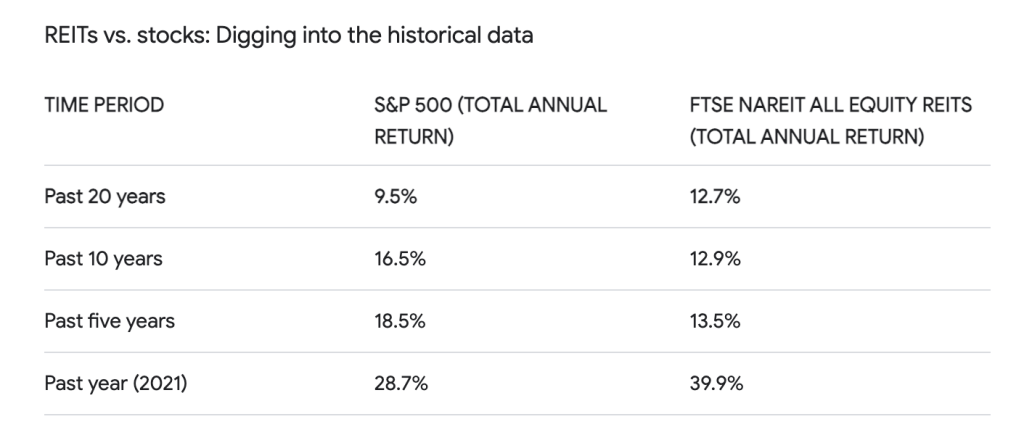
REIT vs Stocks: Historical Data
REITs are a viable alternative with returns that vary with interest rates and property cycles, and they can fall with the stock market.
9. Hire a wealth manager
A wealth manager grows money on your behalf. Many firms reportedly want a minimum in the low six figures, around $250,000, and many people wait until they have 2 to 5 million dollars before looking for one. Funds, institutions and small family offices commonly charge around 1% a year of the assets they manage.
The deal: you get to a large enough number, then trust somebody enough to look after it. Compare fees and ask how they are paid before you sign.
10. Automate your learning
You will be just as rich as your mind, so keep it sharp by making learning a habit. Wake up, make your coffee, and get smarter while you drink it. Listen to an audiobook or a podcast, read a few pages, or use a tool designed to build focus.
It is like wealth therapy, and we built the Alux app for exactly that. We pay high-end executive coaches and turn their lessons into daily actionable audio at a fraction of the cost. Get the app here.
The truth about wealth on autopilot
Normally we would write 15 things. We tried here and it didn’t feel right. Anyone who sells you wealth independent of work is hustling you. They are getting rich off your hard-earned money. There is no such thing as a made-for-you system that makes you rich.
If you had a way to turn 1 dollar into 2 dollars, you would run the machine until it stopped. People will always try to sell you the dream, whether through Amazon FBA courses, private investing group memberships or, more recently, ready-made YouTube channels. The only thing of true value is deep education that lets you make progress yourself.
Wealth on autopilot implies you already have so much wealth that the income from it exceeds what you spend. Everything on this list requires you to become someone who is worthy of wealth and can monetize their own skills at any point.
- You get rich by taking a lot of risk with a little bit of money.
- You stay rich by taking very little risk with a lot of money.
The goal is to reach the stay-rich part.
Bonus: there is no magic end or formula
The phone will not ring one day with someone telling you that you’ve made it. Nobody else is keeping track of your race. It will never be automatic and never be easy, and nothing of value comes easily.
You will never have enough, but if you keep running, you will have more than you do now. You can help more people and find purpose in your work. Once you accept that hard work is inevitable, you can focus on making the most of it. Once compounding starts kicking in, you will be well on your way to the life you dream of.
Keep reading
- The truth about passive income: a companion look at what passive really means
- 15 things that compound in life: more on compounding beyond money
- 15 investments that pay you forever: more ways to build recurring income
FAQ
What is autopilot wealth creation?
It is a plan where your assets and other people’s work produce more income than you spend. It requires hard work first, and the work is reduced only after you have built assets that pay you.
How do I automate investing?
Set up an automatic transfer from every paycheck, such as 30%, into retirement accounts and index funds. In tax year 2026, the IRA contribution limit is $7,500.
How much could $10,000 in the S&P 500 grow to?
At the index’s long-run return of about 9.8% a year with dividends, $10,000 grows to about $4.4 million in 65 years in nominal terms, or about $440,000 after inflation at 6% real. Returns are not guaranteed.
Are REITs a good passive investment?
They let you earn rental income without managing tenants, and US REITs must distribute at least 90% of taxable income. They can fall with interest rates and the stock market.
When should I hire a wealth manager?
Many advisers reportedly want at least around $250,000, and many investors wait until they have 2 to 5 million dollars. Fees of around 1% a year are common.
Can I really get rich without working?
Not at the start. Passive income comes after you have built a business, skills or capital. Anyone selling a made-for-you system should be treated with caution.
How we put this list together
We kept the original 10 methods and checked the figures against published index returns, tax-year contribution limits and public records. Where a number is our own arithmetic, such as the 65-year growth of $10,000, we say so and note it is not a forecast.
Last updated: October 2026.