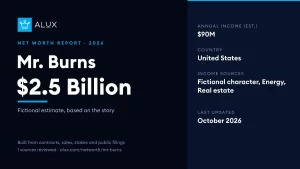
Mr. Burns
- Net worth $2 billion
- Status -
- Country United States
- Source(-s) of wealth Fictional Character
How much is Mr. Burns Worth? Mr. Burns Net Worth in 2026
Mr. Burns’s net worth is estimated at $2.5 billion as of October 2026. Charles Montgomery Burns, known as Mr. Burns, is the fictional owner of the Springfield Nuclear Power Plant in the animated series The Simpsons. The biggest driver of his fortune is the plant itself, the town’s main source of electricity, with decades of investments, a casino plan and a sprawling manor behind it.
| Net worth | $2.5 billion (estimate) |
|---|---|
| Estimated annual income | About $90 million a year (in-story estimate) |
| Born | Fictional character, Springfield (the series often places him at over 100 years old) |
| Country | United States |
| Known for | Owning the the plant, his catchphrase “Excellent”, the hounds |
| Main income sources | Nuclear plant ownership, investments, real estate, casino ventures |
How much is Mr. Burns worth in 2026?
We estimate Mr. Burns’s net worth at about $2.5 billion. This is a fiction exercise: the show treats his wealth as nearly limitless, but never fixes a number, so we have built one from what it shows.
The plant is the core. It powers the town of Springfield and, as the series suggests, the surrounding area. It is also a poor business on paper, with chronic safety lapses, fines and low pay for workers, which we use as a haircut. Over many decades he has also collected a mansion with a vast estate, a private security force, the town’s best lawyers and a habit of buying whatever he wants. A real utility-scale nuclear plant would be worth billions. We pick a value in the low billions because the show also keeps showing him losing and rebuilding money in schemes such as the sun-blocking disc and a short-lived casino.
Mr. Burns in 2026: what they have been working on
- In the show: Burns remains the owner of the plant, as in each season since 1989.
- Core business: The plant supplies Springfield with electricity, and Homer Simpson works there as a safety inspector.
- Side schemes: A giant disc to block the sun and sell more power, a casino, and a drive for oil under Springfield Elementary.
- Estate: Burns Manor, a mansion with grounds, hounds and a private security staff.
- Staff: Waylon Smithers, his loyal assistant, runs his daily affairs.
- Cultural footprint: Burns appears in the series from its earliest seasons and is one of its most recognizable villains.
How Mr. Burns makes money
- the nuclear plant: The main income, selling electricity to the town. It has several known problems, and the plant is shown paying fines.
- Oil: A scheme to slant-drill oil from under Springfield Elementary, which led to an episode-long mystery in the series.
- Casino: A Springfield casino built to win money back from the town.
- Investments and property: Burns Manor and a large land holding. The show hints at old fortunes, antiques and a dusty vault.
- Sun-blocking power scheme: A giant disc to cut sunlight and increase demand for electricity.
- Cost cutting: Low wages, little maintenance, a hired legal team, and the occasional bribe.
What Mr. Burns teaches (and what to take from it)
- Cut costs without cutting what customers value. Burns saves money by cutting safety, and it keeps costing him. Review your costs this week and mark which ones protect your trust with customers or colleagues.
- Do not mistake a fortune for a life. Burns has everything and almost no friends. Schedule one non-work activity with another person this week and keep it.
- Keep a loyal, competent number two. Smithers runs his day. Delegation worked because he trusted him with details. Pick one task you do that someone else could do better.
- Make your moat defensible. The plant is a local monopoly. Think about what keeps your own customers from leaving and write down three reasons.
Career timeline
- Dec 1989: Burns appears in the first season of The Simpsons.
- 1990s: Seasons show the sun-blocking disc, a casino plan and the oil scheme.
- Mid 1990s: A two-part mystery builds around who shot him.
- Later: He is repeatedly shown losing and then regaining his fortune.
Early life and background
The series gives Burns an invented backstory: he is shown as extremely old, with memories from the early 20th century, an education at Yale and a long career of acquisitions. His past is mostly a joke, and details change from episode to episode. That is why we treat his fortune as a modelled figure and not a documented one.
Mr. Burns net worth FAQ
What is Mr. Burns’s net worth?
Mr. Burns’s net worth is estimated at $2.5 billion as of October 2026. This is a fictional estimate based on what the show depicts.
How does Mr. Burns make money?
From owning the Springfield Nuclear Power Plant, plus investments, property and side ventures such as a casino and an oil scheme.
How much does Mr. Burns make per year?
The show never says. We estimate about $90 million a year from plant profits and investments.
How old is Mr. Burns?
The series presents him as over 100 years old, and the exact age changes by episode.
What is Mr. Burns known for?
He is known for owning the Springfield Nuclear Power Plant, his catchphrase “Excellent” and his schemes against the town.
How is Mr. Burns’s net worth estimated?
We value the plant as a utility, add property and investments, subtract losses from his failed schemes, and treat the total as a fiction exercise, not financial advice.
Related profiles
How we estimate net worth
Our estimates are based on public reporting, company valuations, and deal and earnings figures all compiled in an internal valuation model. They are approximate, and figures change over time as new information emerges.
Last updated: October 2026.