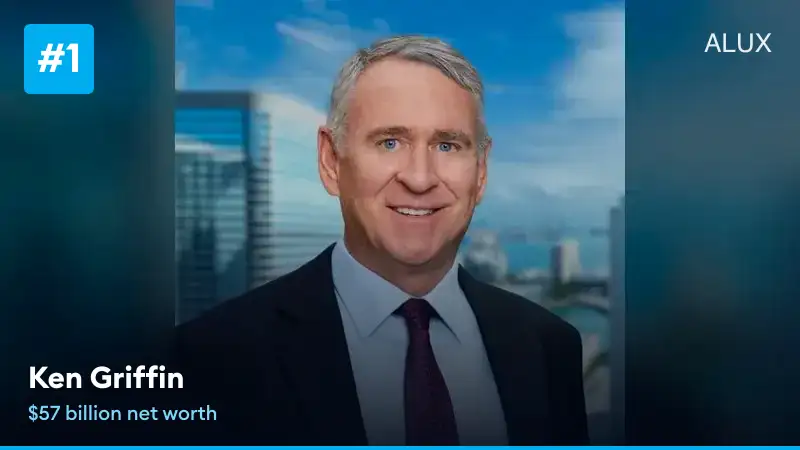
Charles Koch is the richest oil billionaire in the world as of November 2026, with a family fortune we estimate at about $77 billion. This list ranks living people whose wealth was built mainly by finding, piping, refining or selling oil and natural gas. Founders of diversified conglomerates where oil is now a minority of the value, and heirs, appear under Special mentions.
Oil fortunes come in three flavors. There are the American wildcatters who drilled their own wells, the Russian managers who ended up owning the fields they used to run for the state, and a newer Chinese group who started in textiles and worked backward to the refinery. All three are here.
| Rank | Name | Net worth (USD) | Main source of wealth |
|---|---|---|---|
| 10 | Wang Yusuo | $9.5 billion | ENN Group (natural gas) |
| 9 | Richard Kinder | $12.5 billion | Kinder Morgan (pipelines) |
| 8 | Li Shuirong | $14 billion | Rongsheng Petrochemical |
| 7 | Jeffery Hildebrand | $14.2 billion | Hilcorp Energy |
| 6 | Harold Hamm | $19 billion | Continental Resources |
| 5 | Chen Jianhua | $22 billion | Hengli Group (refining, petrochemicals) |
| 4 | Gennady Timchenko | $24 billion | Novatek, Sibur |
| 3 | Vagit Alekperov | $26 billion | Lukoil |
| 2 | Leonid Mikhelson | $27 billion | Novatek, Sibur |
| 1 | Charles Koch | $77 billion | Koch Industries |
The ranking, from 10 to 1
10. Wang Yusuo: $9.5 billion
Wang failed China’s college entrance exam, which in the 1980s was supposed to be the end of the road. Instead he started selling bottled gas in Langfang, a city between Beijing and Tianjin, and kept going. The business became ENN Group, one of China’s largest private energy companies, with more than 40,000 employees and gas pipes running into hundreds of Chinese cities.
ENN now spans gas distribution, LNG trading and a long list of side businesses in property and tourism. Wang has been handing more of the day-to-day work to the next generation, including his son Wang Zizheng, who sits on the board.
His family’s $9.5 billion is anchored by stakes in the listed ENN Energy Holdings and ENN Natural Gas.
9. Richard Kinder: $12.5 billion
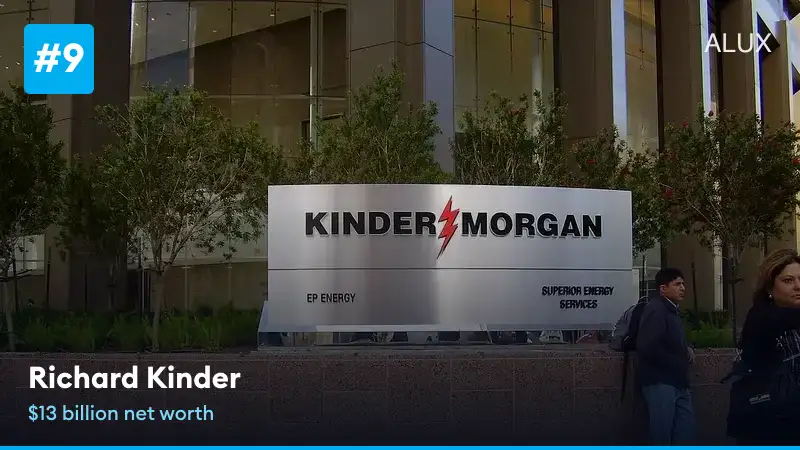
Kinder was the president of Enron until 1996, and leaving when he did may be the best career decision in the history of the energy business. A year later he and Bill Morgan bought a small set of pipeline assets and started Kinder Morgan. Today the company owns or operates about 78,000 miles of pipelines, moving a large share of America’s natural gas.
Kinder famously paid himself a $1 salary as CEO, which works fine when you own a big chunk of the stock. He stepped down as chief executive in 2015 and remains executive chairman. Pipelines are a toll-road business, so his fortune swings less with oil prices than anyone else’s here.
His figure is mostly the market value of his Kinder Morgan shares, priced as of November 2026.
8. Li Shuirong: $14 billion
Li’s Rongsheng group started in polyester and chemical fibers in Zhejiang province and then did something most textile companies never attempt: it built one of China’s biggest oil refineries, on an island off the coast near Zhoushan, to make its own raw materials.
The bet drew in the biggest oil company on earth. In 2023 Saudi Aramco paid $3.4 billion for 10% of Rongsheng Petrochemical, and in 2024 the two agreed to take 50% stakes in each other’s refining subsidiaries in China and Saudi Arabia. Li’s son-in-law, Xiang Jiongjiong, runs the listed company day to day.
We value the family at about $14 billion, almost all of it in Rongsheng Petrochemical’s Shenzhen-listed shares.
7. Jeffery Hildebrand: $14.2 billion
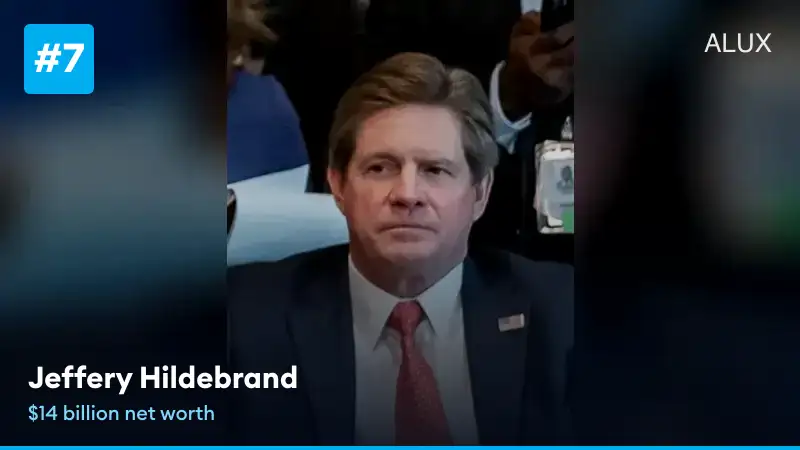
Hildebrand founded Hilcorp in Houston in 1990 and built it into one of the largest privately held oil producers in the U.S., pumping more than 400,000 barrels of oil and gas a day. His specialty is buying old fields that big oil companies have given up on and squeezing more out of them. In 2020 Hilcorp paid $5.6 billion for BP’s assets in Alaska, including a stake in Prudhoe Bay.
He also bought out his cofounding partner for $500 million, so he owns the company outright. And in 2015, after Hilcorp doubled in size in five years, he gave each of his roughly 1,400 employees a $100,000 bonus.
Since Hilcorp is private, we value it against public peers on production and reserves, which lands Hildebrand at about $14.2 billion.
6. Harold Hamm: $19 billion
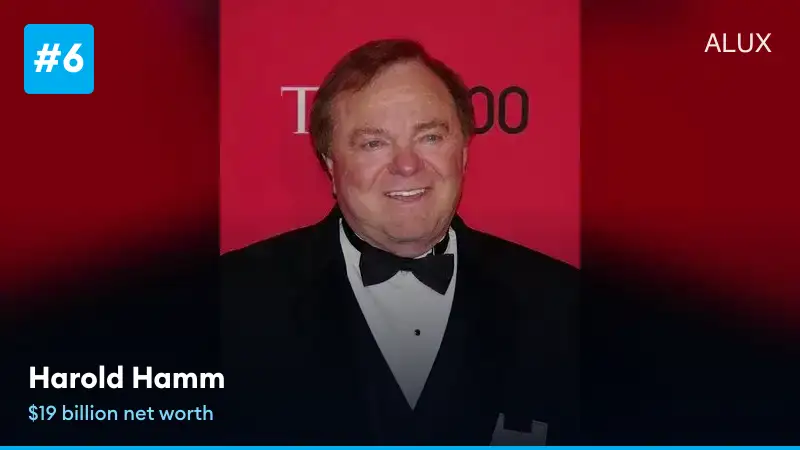
Hamm was the youngest of 13 children of Oklahoma sharecroppers. He started out in the oil patch fixing trucks and pumping gas, bought his own truck at 20, and founded what became Continental Resources in 1967. He was early to the Bakken shale in North Dakota, a bet that helped set off America’s shale boom and made Continental one of the biggest drillers in the country.
In 2022 Hamm took Continental private, buying out the shareholders he did not already own, and spread the ownership among his children. He handed the CEO job to others in 2019, and the family company keeps drilling across North Dakota, Oklahoma and beyond.
We used Continental’s take-private price and its output since then to arrive at about $19 billion for Hamm and his family.
5. Chen Jianhua: $22 billion
Chen and his wife, Fan Hongwei, started with a small weaving factory in Wujiang, near Suzhou, in 1994. By one telling it had 27 workers. Chen bought a bankrupt town-run factory, kept adding looms, and then moved up the supply chain into polyester, then into the chemicals that make polyester, and finally into crude oil itself.
The result is Hengli Group, with an $11 billion refinery and petrochemical complex on Changxing Island in Dalian that can process about 400,000 barrels of crude a day. Hengli ranked 81st among the world’s largest companies by revenue in 2025, with sales of more than $120 billion. Fan chairs the listed arm, Hengli Petrochemical, and Chen chairs the group.
The $22 billion figure covers the couple’s combined stakes in Hengli Petrochemical and related listed companies.
4. Gennady Timchenko: $24 billion
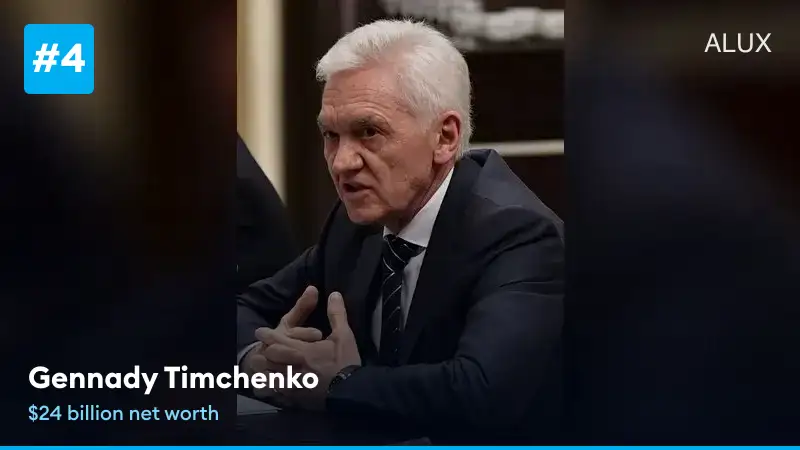
Timchenko is an energy trader by training. In 1997 he cofounded Gunvor with Swedish partner Torbjörn Törnqvist, and it grew into one of the world’s biggest independent oil traders, shipping a large share of Russia’s crude exports. He sold his Gunvor stake to Törnqvist in 2014.
His fortune today sits in Volga Group, his investment firm, which holds big stakes in gas producer Novatek and petrochemical company Sibur, both partnerships with Leonid Mikhelson. Outside work he chairs the SKA Saint Petersburg ice hockey club and the Kontinental Hockey League.
Our estimate of about $24 billion is built on his Novatek and Sibur holdings plus Volga Group’s other assets.
3. Vagit Alekperov: $26 billion
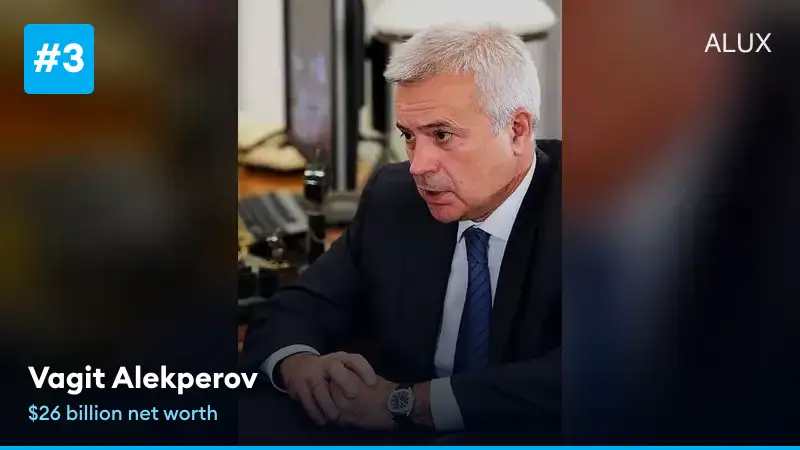
Alekperov was born in Baku in 1950, studied at the Azerbaijan Oil and Chemistry Institute and worked his way up through the Soviet oil fields of Western Siberia. By 1990 he was deputy minister of the Soviet oil and gas industry, reportedly the youngest in its history. When the Soviet Union broke up, he combined three big oil fields into a company called Langepas-Uray-Kogalymneft, better known by its initials: Lukoil.
Lukoil became Russia’s largest independent oil company, and Alekperov slowly bought up shares until he owned about 30%. He stepped down as president in 2022 but still collects the dividends: nearly $2.4 billion in 2025 alone. He has said his stake will go to a charitable foundation under his will.
We discount his roughly 30% of Lukoil for the company’s shrinking foreign business, which is why we land below the highest published estimates, at about $26 billion.
2. Leonid Mikhelson: $27 billion
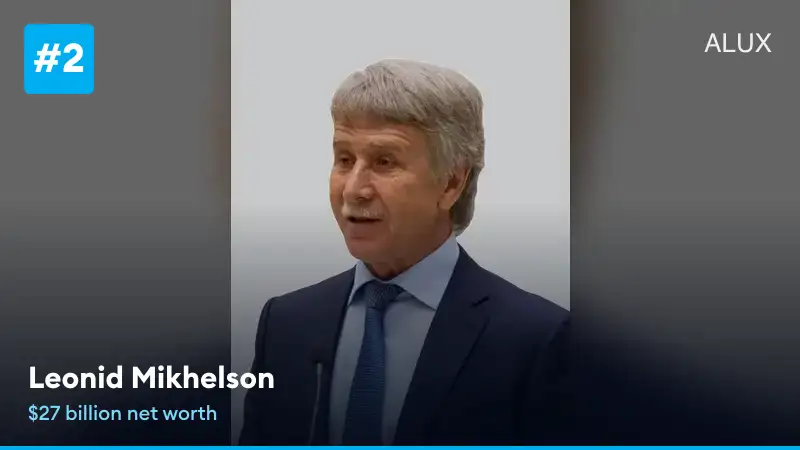
Mikhelson started as a construction foreman laying gas pipelines across Siberia in the late 1970s. In the 1990s, the pipeline builder he ran in Samara became one of the first companies privatized in Russia, and he used it as a base to found Novatek, now the country’s largest independent natural gas producer and the company behind the giant Yamal LNG plant in the Arctic.
He owns about a quarter of Novatek and roughly 30% of Sibur, Russia’s biggest petrochemical company. He also spends on art: his V-A-C Foundation turned a century-old Moscow power station into the GES-2 arts center, designed by Renzo Piano’s studio.
Novatek’s share price and Sibur’s private valuation drive his number, which we put at about $27 billion.
1. Charles Koch: $77 billion
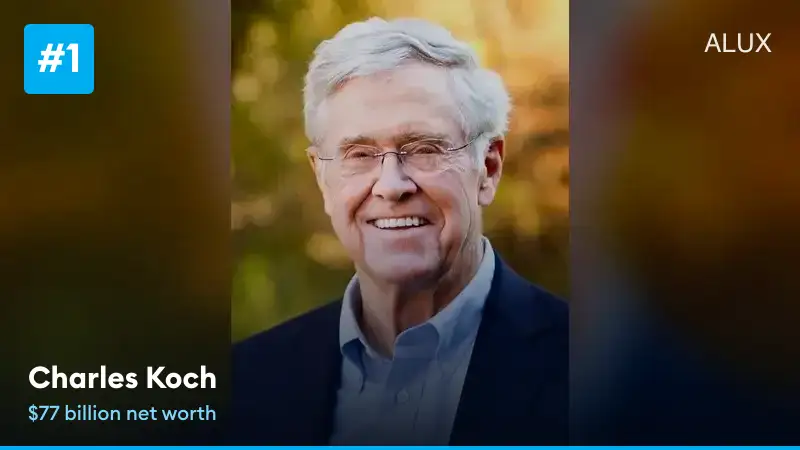
The Koch fortune starts in 1927, when Fred Koch came up with a better way to turn heavy crude into gasoline. His son Charles took over the family firm in 1967, renamed it Koch Industries, and turned a mid-sized oil refiner into America’s second-largest private company, with about $125 billion in annual revenue.
Oil is still at the core: Koch runs refineries through Flint Hills Resources and a large pipeline network. But Charles used the cash to buy chemicals, paper (Georgia-Pacific, the people behind Dixie cups), electronics and software. He still controls 42% of the voting shares, though between 2020 and 2022 he moved about $5.3 billion of nonvoting stock to two nonprofits. Now past 90, he is still chairman.
Our model values Koch Industries on peer multiples for each division, then applies the share of Charles Koch and his family to reach about $77 billion.
Special mentions
- Mukesh Ambani (about $92 billion): Reliance runs the world’s largest refining complex at Jamnagar, but most of Ambani’s wealth now comes from telecom and retail. Jio Platforms listed in October 2026 at about $137 billion.
- Julia Koch and family (heirs): they hold the 42% of Koch Industries that belonged to David Koch. The fortune is large, but it was inherited.
- Philip Anschutz (about $19 billion): started in his father’s oil business, then made far more from railroads, telecom and AEG, the sports and concert company behind more than 70 arenas.
What the richest oil billionaires have in common
Almost nobody on this list started with a gusher. Hamm fixed trucks, Mikhelson laid pipe, Chen ran looms and Wang sold gas canisters. The fortunes came from controlling a bottleneck: a pipeline network, a refinery, a gas field with export rights. Producers who only drill are exposed to the price of a barrel, and their wealth swings with it. Those who own the pipes, the refineries or the trading desks get paid on volume, whatever the price. Look at the top half of the list and you see refiners, gas producers with their own export routes and a conglomerate that started as a refinery. Pure drilling stops at Hamm.
The habits that let people afford this
Short audio lessons on money, mindset and discipline, in the Alux app.
Get the Alux app →FAQ
Who is the richest oil billionaire in the world?
Charles Koch is the richest oil billionaire as of November 2026, with a family fortune of about $77 billion from Koch Industries, which began as an oil refiner.
Who is the richest oil billionaire in the United States?
Charles Koch again. The richest American who made his money purely from drilling is Harold Hamm of Continental Resources, at about $19 billion.
Why is Mukesh Ambani not ranked?
Reliance still refines oil, but most of Ambani’s fortune now comes from its telecom and retail businesses, so we list him under Special mentions.
How much does the number 10 oil billionaire have?
Wang Yusuo, founder of China’s ENN Group, ranks 10th with about $9.5 billion from natural gas distribution.
How do oil billionaires make their money?
Most own the scarce part of the chain: pipelines, refineries or gas fields with export routes. Those businesses earn on volume, which makes them steadier than drilling alone.
Are there Chinese oil billionaires on the list?
Three: Chen Jianhua of Hengli Group, Li Shuirong of Rongsheng Petrochemical and Wang Yusuo of ENN. Two of them started in textiles and built refineries to make their own raw materials.
How we estimate net worth
Our estimates are based on public reporting, company valuations, and deal and earnings figures all compiled in an internal valuation model. They are approximate, and figures change over time as new information emerges.
Keep reading
- 15 self-made billionaires who were once poor
- What economic moats are and how they protect wealth
- The most common ways to become a self-made billionaire
Last updated: November 2026.