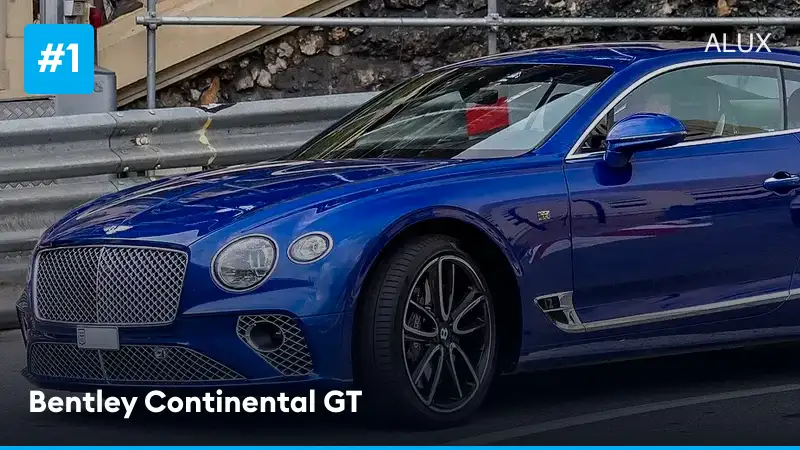
Johann Rupert is the richest person in South Africa as of November 2026, with a family fortune we estimate at about $14.4 billion, built on Cartier’s parent company Richemont and the Remgro and Reinet investment groups. This list ranks people the global wealth trackers count as South African citizens, whether they built their fortune themselves or took over a family business and grew it. South African-born billionaires who are now counted as citizens of other countries are covered in the special mentions.
By our count nine South Africans now hold fortunes above $1 billion: the eight on the global billionaire lists plus Zak Calisto, whose Nasdaq-listed stake has climbed past the mark. Two of them owe most of their wealth to one Stellenbosch bank, a fact that tells you a lot about where South African money has been made this century.
| Rank | Name | Net worth (USD) | Main source of wealth |
|---|---|---|---|
| 10 | Adrian Gore | $760 million | Discovery (insurance, banking) |
| 9 | Zak Calisto | $1.2 billion | Karooooo (Cartrack vehicle tracking) |
| 8 | Paul van Zuydam | $1.6 billion | Le Creuset cookware |
| 7 | Christo Wiese | $2.1 billion | Shoprite, Premier, Pepkor legacy |
| 6 | Jannie Mouton and family | $2.1 billion | Capitec, PSG Financial Services shares |
| 5 | Patrice Motsepe | $2.5 billion | African Rainbow Minerals, Sanlam, ARC |
| 4 | Koos Bekker | $3.3 billion | Naspers and Prosus (Tencent) |
| 3 | Michiel le Roux | $4.0 billion | Capitec Bank |
| 2 | Nicky Oppenheimer and family | $10.6 billion | De Beers sale, private investments |
| 1 | Johann Rupert and family | $14.4 billion | Richemont, Remgro, Reinet |
South Africa’s 10 richest people, counted down
10. Adrian Gore: $760 million
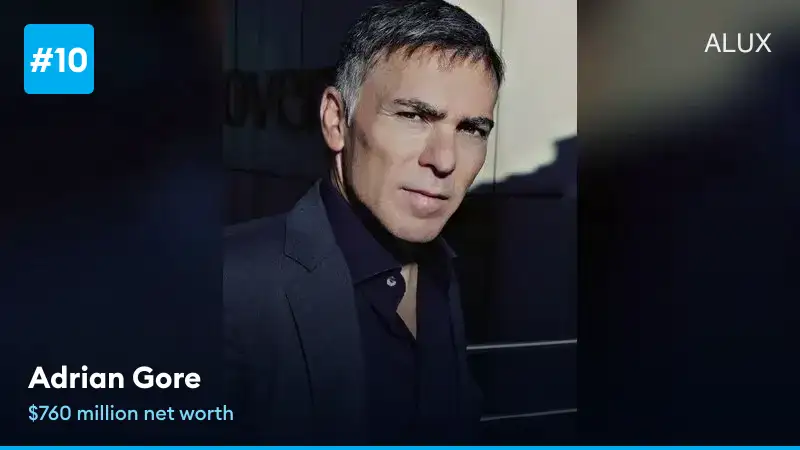
In 1992 an actuary in his late twenties talked Rand Merchant Bank into backing a health insurer with R10 million of seed money. That company became Discovery, and Adrian Gore has run it ever since. Its big idea was Vitality, a scheme that pays people in discounts and cashback for walking, eating better and turning up for check-ups. Insurers in the US, the UK and China now license the model.
Discovery has since added life cover, investments, car insurance and a digital bank. Gore sold about R50 million of shares in December 2025 and collected a dividend of roughly $3 million in the first half of 2026, which tells you how much of his money is still sitting in the company he started.
Our figure is his direct holding of about 45.6 million Discovery shares, close to 6.7% of the company. At the closing price on 10 November 2026 that stake was worth about $754 million, and the interim dividend adds about $3 million, for a total of about $760 million. We leave out the proceeds of his December 2025 share sale, on the assumption that the money was taxed, spent or reinvested.
9. Zak Calisto: $1.2 billion
Zak Calisto started Cartrack in 2001 to find stolen cars in Johannesburg, a business with no shortage of customers. He then noticed that companies cared less about theft and more about where their delivery vans were at 3 p.m. and how much fuel they burned getting there. Cartrack turned into a fleet software company with subscribers across Africa, Asia, Europe and the Americas.
The group was restructured as Karooooo, with five o’s, and listed on Nasdaq in 2021, with a secondary listing in Johannesburg. Calisto still holds a majority of the shares directly, which makes him one of the few South African founders whose stake trades in dollars on a US exchange.
Company filings show him holding about 17.6 million shares directly as of August 2026, roughly 57% of Karooooo. At the 10 November 2026 price that stake is worth about $1.12 billion, and cash left from share sales and dividends after tax adds about $90 million, for a total of $1.2 billion. Some rankings credit him with about 75% of the company, a figure the filings do not support. The stock moves sharply on each quarterly result, so this number can swing by a few hundred million in either direction.
8. Paul van Zuydam: $1.6 billion
Paul van Zuydam grew up as one of seven children on a South African farm and spent his career in Canada, Britain and Europe. In the late 1980s he visited a struggling cast-iron cookware factory in northern France while working for another company. When that company was sold and the deal fell through, he resigned and bought the business himself.
The business was Le Creuset. He cut it back to its main plant in Fresnoy-le-Grand, automated the lines, doubled cast-iron capacity and pushed the orange casserole dish into American and Asian kitchens. The company has reportedly carried no outside debt since 2001 and brings in around $850 million a year in sales.
He entered the billionaire ranks in December 2025, at 87, the oldest of South Africa’s dollar billionaires. He lives in Switzerland today but is still counted as a South African citizen. We value his private ownership of Le Creuset against listed homeware and premium consumer brands, which lands at about $1.6 billion.
7. Christo Wiese: $2.1 billion
Christo Wiese joined Pep Stores, his family’s discount clothing chain, in 1967 and later turned it into Pepkor, one of the biggest budget retailers in Africa. In 1979 he bought control of a small grocery chain called Shoprite, which grew into the continent’s largest supermarket group with thousands of stores.
His fortune once topped $5 billion. Most of it was tied to a European retail group he had merged Pepkor into, and when its shares collapsed in 2017 he lost the bulk of his paper wealth almost overnight. He rebuilt around what was left: about 11% of Shoprite, about 36% of food maker Premier, and smaller holdings in Brait, Invicta and Collins. Outside the listed stakes he owns the Lourensford wine estate near Somerset West.
At 10 November 2026 prices his 63.1 million Shoprite shares were worth about $1.3 billion and his Premier stake about $700 million, with the three smaller holdings adding about $250 million. We subtract about $140 million for Shoprite shares his holding company owes under a 2026 share loan and settle at about $2.1 billion. Shoprite has risen about 16% since June, which is why he is worth more than estimates from earlier in the year.
6. Jannie Mouton and family: $2.1 billion
Jannie Mouton was pushed out of the stockbroking firm he co-founded when he was 48. In 1995 he started again with a small investment company called PSG, run out of Stellenbosch with a handful of partners. PSG’s best bet was a tiny lender founded in 2001: Capitec. It also launched private school group Curro and financial adviser PSG Konsult.
PSG Group was wound up and its holdings handed to shareholders in 2023, which turned the Moutons’ indirect stakes into direct ones. The family trust holds large blocks of Capitec and PSG Financial Services, the former PSG Konsult, and Capitec’s market value crossed R500 billion in January 2026.
Our figure covers the JF Mouton Family Trust. Its 5.9 million Capitec shares were worth about $1.79 billion on 10 November 2026 and its 163.7 million PSG Financial Services shares about $311 million, and after-tax dividends add about $23 million. That gives about $2.1 billion. Mouton’s son Piet holds his own Capitec shares, worth about $2 billion more, which we count as his rather than the trust’s. Estimates of $2.7 billion from earlier in 2026 predate Capitec’s fall in the third quarter.
5. Patrice Motsepe: $2.5 billion
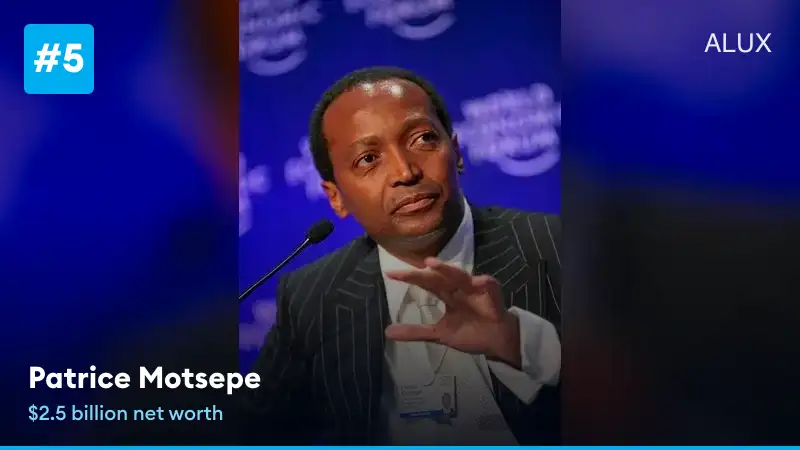
Patrice Motsepe trained as a lawyer and became the first Black partner at Johannesburg law firm Bowman Gilfillan. In the 1990s he bought gold mine shafts that bigger miners considered too old to bother with, ran them cheaply and made them pay. Those shafts became the base of African Rainbow Minerals, which now mines platinum, iron ore, manganese, coal and gold.
His family trusts own about 90 million ARM shares, control Ubuntu-Botho Investments, which holds 292.5 million Sanlam shares, and hold a large stake in African Rainbow Capital, which backs TymeBank among other businesses. He also owns Mamelodi Sundowns, the most successful club in South African football, and he is president of the Confederation of African Football.
ARM’s shares fell 27% between the end of 2025 and late October 2026 with weaker metal prices, and on 10 November his stake was worth about $834 million. His family trusts own about 61% of Ubuntu-Botho, so their slice of its Sanlam shares is worth about $961 million. His side’s share of the African Rainbow Capital portfolio and of Tyme Group, the digital bank, adds about $565 million, and we allow $150 million for cash, the football club and other assets. That gives about $2.5 billion. Published estimates near $3.5 billion count all of Ubuntu-Botho’s Sanlam shares and the whole ARC stake as his, including parts held for a community trust that are not his to spend.
4. Koos Bekker: $3.3 billion
Koos Bekker made one of the best bets in corporate history and then refused a salary for years so he could share in it. As chief executive of Naspers from 1997, he backed a little Chinese messaging company called Tencent in 2001, paying about $32 million for a stake that later grew to be worth more than $100 billion. Instead of pay, he took share options.
He stepped down as CEO in 2014 and returned as chairman of Naspers and its Amsterdam-listed arm Prosus. His family trust has sold more than R6 billion of Prosus shares over the years, and some of that money went into Babylonstoren, a restored Cape Dutch farm and hotel near Franschhoek, and The Newt, a country estate in Somerset, England.
2026 has been unkind to him. Naspers and Prosus had both fallen more than 35% for the year by early October, and his fortune slid from about $4 billion in January to around $3.2 billion. It has since steadied, and we put it at about $3.3 billion in November, built on his shares and options plus the hotels.
3. Michiel le Roux: $4.0 billion
Capitec opened in 2001 with a simple plan: cheap fees, long opening hours and branches where working South Africans actually live. Michiel le Roux was one of its founders, later its chairman, and one of its first big shareholders. Twenty-five years later Capitec is the country’s largest bank by number of clients and, in January 2026, it became the fastest South African company to reach a R500 billion market value.
He still owns about 11.4% of the bank. In July 2026 he raised R6.5 billion by borrowing against part of that stake, a common move for founders who want cash without selling shares. He keeps a low profile in Stellenbosch, where Capitec still has its head office.
At Capitec’s closing price on 10 November 2026, his 13.2 million shares were worth about R65.6 billion, or $4.0 billion. We take that as his net worth, since the loan is roughly offset by the cash it raised and his private holdings, which include a stake in the Stormers rugby franchise.
2. Nicky Oppenheimer and family: $10.6 billion
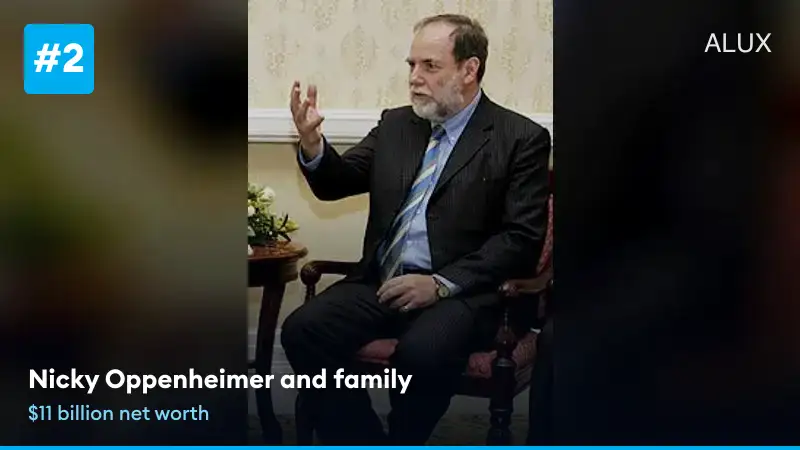
For three generations the Oppenheimers ran De Beers, the company that controlled most of the world’s diamond trade. Nicky Oppenheimer was its chairman until 2012, when the family sold its 40% stake to Anglo American for $5.1 billion in cash. It was one of the largest private paydays in African history, and the timing looks better every year as lab-grown stones squeeze natural diamond prices.
The family invested the money through Oppenheimer Generations, which holds private equity, property and listed shares around the world. Closer to home, they own Tswalu Kalahari, the largest private game reserve in South Africa, and Fireblade Aviation, which runs a private terminal at Johannesburg’s main airport.
We started from the 2012 sale proceeds, added more than a decade of investment returns and subtracted spending and the reserve’s running costs. The result, about $10.6 billion, has barely moved in 2026.
1. Johann Rupert and family: $14.4 billion
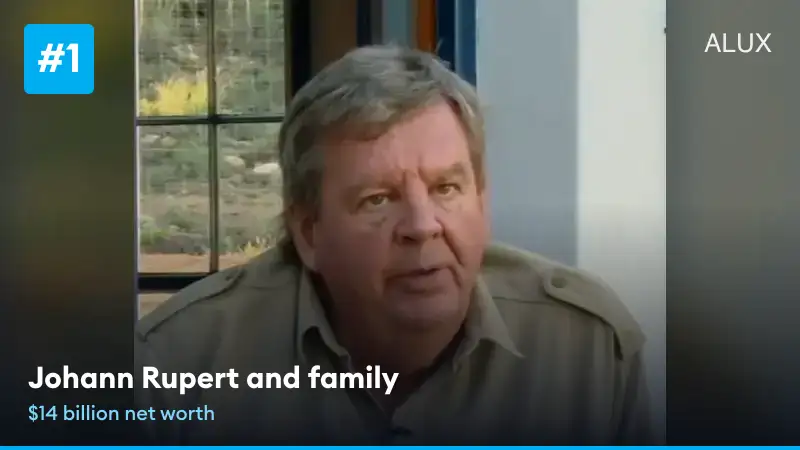
Johann Rupert inherited a tobacco and liquor business from his father, Anton, and turned part of it into something far more valuable. In 1988 he created Richemont, which owns Cartier, Van Cleef & Arpels, Montblanc, IWC and a long list of other luxury names. Today it is one of the world’s largest luxury goods companies.
The family controls Richemont through special shares that give it voting power well above its economic stake. It also holds big positions in Remgro, the Stellenbosch investment group, and Reinet, which owns a large stake in British American Tobacco and other assets. Rupert has his own hobbies as well: the Leopard Creek golf estate beside the Kruger National Park and the L’Ormarins wine farm in Franschhoek.
Richemont’s jewellery sales have held up better than most luxury rivals in 2025 and 2026, and his fortune rose by more than $1 billion between March and September. Working from the dividend the family received in 2026, we put its economic share of Richemont at about 57 million share equivalents, worth about $12.2 billion at the 10 November price. Remgro adds about $600 million, the Rupert trusts’ quarter of Reinet about $1.2 billion, and we allow $400 million for cash, wine estates and other private assets. That gives about $14.4 billion, well ahead of the next fortune on the list. Published estimates in 2026 have run from about $15 billion to above $19 billion, mostly struck at higher Richemont prices.
Special mentions
- Elon Musk: Born in Pretoria in 1971 and the richest person on the planet, but he left South Africa at 17 and built Tesla and SpaceX in the US, so he sits outside this ranking.
- Ivan Glasenberg: The Johannesburg-born former chief executive of Glencore holds a multibillion-dollar stake in the commodities trader. He has lived in Switzerland for decades.
- Patrick Soon-Shiong: Born in Port Elizabeth, he made his fortune in the US by selling cancer drug maker Abraxis and other biotech businesses, and he lives in Los Angeles.
- Nathan Kirsh: The Potchefstroom-born investor once owned the Checkers supermarket chain and made most of his money from US cash-and-carry wholesaler Jetro. He is based in Eswatini and London.
What South Africa’s richest people have in common
- Stellenbosch is the money town. Rupert’s Remgro, Capitec, PSG and Mouton’s family trust are all run from the same small winelands town. Three of the top ten have a direct link to it.
- One bank made two of the fortunes. Le Roux and the Moutons, plus a long tail of smaller JSE investors, got rich on Capitec. Few countries have a single listed company doing so much of the heavy lifting.
- The big money leaves the rand. Rupert’s luxury brands earn in euros and Swiss francs, Bekker’s wealth rests on a Chinese tech company, and Oppenheimer’s is invested globally. The fortunes tied mostly to the local economy, such as Motsepe’s, have had a rougher 2026.
- A second act is common. Mouton started PSG after being fired, Wiese rebuilt after losing most of his fortune, and van Zuydam bought Le Creuset after a deal fell apart around him.
The habits that let people afford this
Short audio lessons on money, mindset and discipline, in the Alux app.
Get the Alux app →FAQ
Who is the richest person in South Africa in 2026?
Johann Rupert is the richest person in South Africa, with a family fortune we estimate at about $14.4 billion as of November 2026. Most of it comes from his control of luxury group Richemont and his stakes in Remgro and Reinet.
How many billionaires does South Africa have?
Eight South Africans are on the global billionaire lists in 2026: Rupert, Oppenheimer, le Roux, Motsepe, Bekker, the Mouton family, Wiese and Paul van Zuydam, who joined the group in December 2025. By our count Zak Calisto makes nine, because his Nasdaq-listed stake alone is now worth more than $1.1 billion.
Is Elon Musk on the list of richest South Africans?
No. Musk was born in Pretoria but left South Africa as a teenager and built his fortune in North America, so we list him under special mentions rather than in the ten.
How much money does number 10 on the list have?
Adrian Gore, the founder of Discovery, is tenth with about $760 million, almost all of it in Discovery shares.
Who is the richest Black person in South Africa?
Patrice Motsepe, the founder of African Rainbow Minerals, with an estimated $2.5 billion. He is fifth on our list.
Which South African billionaire lost the most money in 2026?
Koos Bekker, whose fortune fell from about $4 billion in January to around $3.2 billion by October as Naspers and Prosus shares slumped.
How we estimate net worth
Our estimates are based on public reporting, company valuations, and deal and earnings figures all compiled in an internal valuation model. They are approximate, and figures change over time as new information emerges.
Keep reading
- The most common ways people become self-made billionaires
- How family offices manage billionaire fortunes
- The best luxury hotels in Cape Town
Last updated: November 2026.