The smartest way to invest $1 million is to clear expensive debt, keep a cash reserve, put the rest into a mix of broad stock funds and high-quality bonds you can stomach in a crash, and take out only what the plan can survive. Having a million should make life easier, yet the moment it lands in your account every mistake feels more expensive. What you want is simple enough: keep it growing, avoid losing a big chunk of it, and enjoy some of it before you are too old to care.
This breakdown walks through the decisions in order, using a 40-year-old with $1 million after tax, a separate home and an income that still covers the bills. It covers how much to invest, whether to buy all at once, where the money goes, what a bad year does to the plan and how much you can safely spend.
Watch the full video here, or skip to the breakdown below.
The 5 decisions at a glance
- How much of the million can you actually invest (0:44)
- Should you invest the whole million tomorrow (3:57)
- Where does the money go (8:21)
- What happens when the plan gets hit (12:34)
- How much can you take out and still keep your freedom (15:36)
1. How much of the million can you actually invest
Before hunting for an investment, check whether you are paying someone a ridiculous amount to borrow their money. $20k of debt at 20% interest costs roughly $4k a year just to keep the balance hanging around. Clearing it removes that bill, and finding an investment that reliably beats it is a much harder assignment.
A cheap fixed-rate mortgage is less clear cut. Paying it off feels good and lowers your monthly costs, but if it eats most of your cash you end up with a paid-off house and little money for anything else. You still own the value, you just cannot ask the kitchen to transfer you $10k. The rate matters, and so does what you have left afterward.
In this example the expensive debt is gone, so $60k goes aside for emergencies and bills you already know are coming. Someone with unpredictable income and children may need more. That reserve belongs somewhere easy to reach, such as an insured bank account within its limits or short-term government bills.
Caution can go too far. Leave the full million earning nothing for 10 years with 3% inflation and it buys about what $744k buys today. So the money you need soon stays accessible, and the remaining $940k goes to work.
Kill expensive debt and set aside a reserve before you invest a single dollar.
2. Should you invest the whole million tomorrow
With that much cash ready, there is a nagging fear: what if you buy everything today and the market crashes tomorrow? To test it, the video compares two approaches with an S&P 500 fund, reinvested dividends and waiting cash earning Treasury bill interest. One puts the full $1 million in at once. The other invests $200k at the start of each year for five years, which is called dollar-cost averaging.
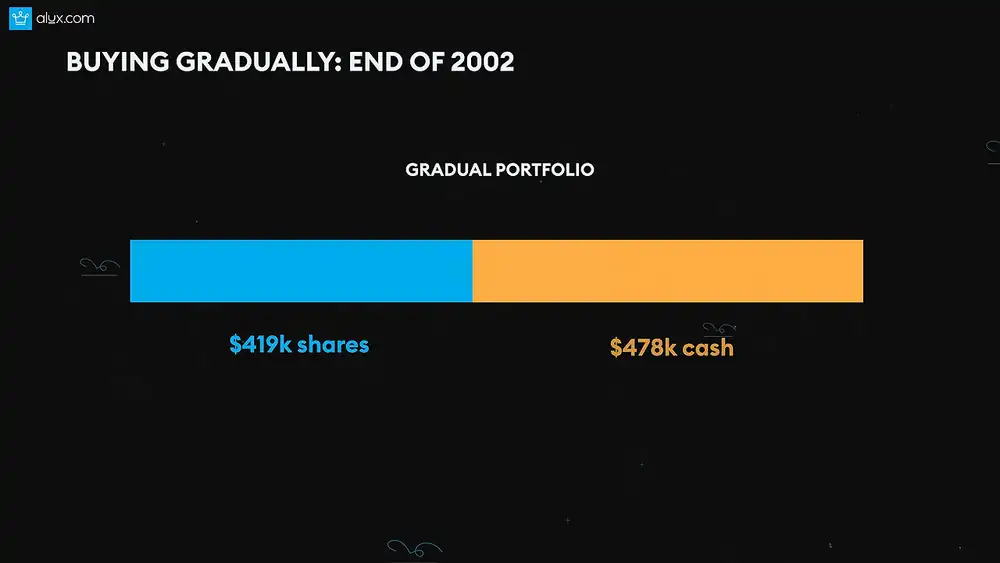
Start in January 2000, just before the dot-com crash. By the end of 2002, the lump sum is worth about $626k. The gradual buyer has roughly $419k in shares plus about $478k still in cash, around $897k in total. By the end of 2004 the gap widens: about $889k for the lump sum against about $1.18 million for the gradual plan.
Shift the start to January 2003, ahead of strong years, and the result flips. By the end of 2007 the lump sum reaches roughly $1.82 million while the gradual buyer has about $1.40 million, around $417k behind.
Those dates were picked to show contrast, and nobody knew the next five years in advance. Across wider history, one large fund company found that investing immediately beat spreading purchases out roughly two thirds of the time, though its main test used a three-month schedule. If a lump sum would make you panic-sell after the first drop, a fixed schedule with set dates and an end point can help you stick with it.
Waiting is not automatically the careful choice, and once the money is in, a crash still hits all of it.
3. Where does the money go
The plan puts $600k into broad stock funds and $340k into high-quality bonds, with the $60k reserve completing the million. Those proportions are a starting point to test, not a magic formula.
Stocks give you a stake in businesses that can grow, and spreading them across the world means the plan does not depend on one country having another great decade. More funds do not always mean more variety: a technology fund next to a broad US fund can buy many of the same companies twice, so look at what sits underneath the fund names.
Bonds are the steadier half, but the word alone says little about safety. A struggling company offers a juicy rate because you might not get everything back, and even government bonds can fall sharply in price if rates move, especially long-dated ones. This example leans toward high-quality bonds with short or medium terms, perhaps with some inflation-linked government bonds. If you spend in euros or another currency, match the money you need soon to the bills you will pay.
Fancier options are allowed, not required. A private deal can lock money up for years. A $400k rental puts 40% of the million into one building. And a 1% annual fee costs $10k in year one: at an assumed 6% for 20 years the million reaches about $3.21 million, while at 5% it reaches about $2.65 million, a gap of roughly $554k.
Funds, bonds and some cash can be the whole answer, and every fee point compounds against you.
4. What happens when the plan gets hit
Run the plan through a bad year: shares fall 40%, bonds fall 10% and the cash stays flat. The $600k in stocks becomes $360k, the bonds drop to $306k, and with the $60k reserve you are looking at $726k. A diversified plan still lost $274k.
Sit with that number before investing. If seeing it would make you sell everything, you probably need less in stocks, and it is far easier to adjust now than to find your limit after the fall. Do not count on bonds always rising when shares drop either. In 2022 the S&P 500 and the 10-year US Treasury series used in this research both lost around 18%.
Now suppose your income stops and you need $40k for a year. The reserve covers it without forcing you to sell shares at the bottom, which buys time to find income or adjust. It cannot promise a recovery before it runs out. Watch for income and investments that can fall together too: a tech worker holding employer shares and tech funds has nearly everything riding on one industry.
Good years need attention as well. If stocks rise 40% while the rest stays flat, you hold $840k of $1.24 million, almost 68% in stocks instead of 60%. Rebalancing back would mean moving $96k out of stocks. Pick a review schedule, think about taxes, and write the rules down before anything dramatic happens.
Decide how much loss you can live with on paper before the market decides for you.
5. How much can you take out and still keep your freedom

A million you are scared to touch is not much fun. The easy maths says it earns 7%, so spend $70k a year. Returns do not arrive like a salary, though, and the bad years do lasting damage if you keep spending as if they did.
Order matters. Withdraw $50k at the end of each year from a million that gains 20% then loses 20%, and you finish with $870k. Flip the order and you finish with $850k. Without withdrawals both end at $960k. Taking money out after an early loss leaves less invested for the recovery.
One 2025 study arrived at a starting withdrawal rate of 3.9%, or $39k on a million before tax. That figure assumed spending rising with inflation and aimed for money to remain after 30 years in 90% of modeled outcomes. It did not promise the original million survives, and at 40 you may need the money for longer than 30 years.
Because earnings still cover the bills here, the example takes $20k a year to start, 2% of the million. That could mean working a little less or doing something you keep postponing, and optional spending can be cut after a bad year. Fund it through interest, dividends and planned sales rather than chasing high payouts. Then decide what keeping the million means: a balance above $1 million, the buying power of a million today, or spending it down over your life.
Your safe spending rate depends on what you want the million to still be doing in 30 years.
A plan for the bad years too
You can think all of this through and still buy right before a decline, keep costs low and still have a disappointing year, or watch someone taking bigger risks out-earn you for a while. None of that means the plan failed.
The money has to support the life you want, including the years when investing goes badly. If it gives you more time, makes you less dependent on the next paycheck and keeps enough invested for the future, the million can make a real difference without every decision being perfect.
FAQ
Should I invest $1 million all at once or over time?
Historically, investing immediately has beaten spreading purchases out roughly two thirds of the time in one large fund company’s comparisons. If a lump sum would make you panic and sell after the first drop, a fixed buying schedule with set dates and an end point can help you stick with the plan.
How much cash should I keep if I have $1 million?
The example keeps $60k aside for emergencies and known expenses in an insured bank account or short-term government bills. Your number depends on how predictable your income is and who depends on you.
What is a good stock and bond split for $1 million?
The example uses $600k in broad global stock funds, $340k in high-quality short or medium-term bonds and a $60k cash reserve. Treat it as a starting point and test it against a bad year before committing.
How much can I withdraw from $1 million per year?
A 2025 study put a starting rate at 3.9%, or $39k a year, assuming inflation-adjusted spending over 30 years. Someone younger, like a 40-year-old, may need the money to last longer, so a lower rate such as 2% leaves more room.
How much does a 1% advisor fee cost on $1 million?
It costs $10k in the first year. Over 20 years, the difference between a 6% and a 5% return on a million is roughly $554k.
Do bonds always go up when stocks fall?
No. In 2022 both the S&P 500 and the 10-year US Treasury series used in the research lost around 18%.
Keep reading