Airlines look like companies that sell seats, but underneath they manage huge debts on leased machines that only earn money in the air and leave the moment the payments stop. The airline business crossed one trillion dollars in revenue in a single year, yet it runs on margins thinner than a corner grocery store’s. The case made here is that cheap fares rest on a stack of borrowed planes, fuel bets and fees, and that one missed payment can end an airline overnight.
This breakdown follows the money chapter by chapter: the cost of starting an airline, the 1978 law that opened the market, the leasing trick behind most fleets, the Boeing and Airbus duopoly, the maths of load factor, the fee model, fuel hedging, a long list of collapses and the 48 hours that ended the Australian startup Bonza.
Watch the full video here, or skip to the breakdown below.
The chapters at a glance
- The grounded jets of Moses Lake (0:00)
- Chapter 1: The price of admission (3:18)
- Chapter 2: The law that built the whole industry (12:09)
- Chapter 3: The leasing secret (18:38)
- Chapter 4: Two companies, every plane (28:10)
- Chapter 5: The math that never quite works (37:14)
- Chapter 6: The fees you didn’t used to pay (42:13)
- Chapter 7: The fuel gamble (47:48)
- Chapter 8: A pattern, not an accident (53:26)
- Chapter 9: The forty-eight hours (1:04:05)
- Conclusion: The mechanism (1:07:52)
The grounded jets of Moses Lake

In the summer of 2019, hundreds of Boeing 737 MAX jets sat nose to tail on desert tarmac in Moses Lake, Washington, engines wrapped in plastic. Regulators had pulled the model from service through March 2019, with the United States joining last on March 13, and every MAX stayed grounded for 619 straight days.
The order followed two crashes that killed 346 people: Lion Air Flight 610 in October 2018 and Ethiopian Airlines Flight 302 five months later. Investigators traced both to a program that adjusted the plane’s nose automatically while trusting a single sensor. Boeing absorbed roughly 20 billion dollars in direct costs, airlines waiting on jets an estimated 60 billion more, and a 2021 settlement added over 2.5 billion.
Behind those numbers sits a 1950 rule that lets plane makers certify parts of their own aircraft. Running that testing independently would cost the FAA an estimated 2 billion dollars and 10,000 more staff, which is why the same delegation system still certifies nearly every commercial jet built.
The checking you trust before takeoff is often done, in part, by the company selling the plane.
Chapter 1: The price of admission
Starting an airline ranks among the most expensive ways into any industry. You need pilots certified on your exact aircraft, an approved maintenance program, insurance on machines worth tens of millions each, ground staff at every airport and a safety certificate that can take months. None of it earns a dollar.
JetBlue raised 128 million dollars before its first flight on February 11, 2000. Allegiant, by contrast, went through Chapter 11 around 2000 and was rebuilt by Maurice Gallagher on cheap old MD-80s and strict cost control, becoming one of the most consistently profitable US airlines.
Research backs the boring approach. A 2009 study of European startups found that undercutting every rival on fare gave no survival edge, while a cost structure able to carry the worst quarter did. A 2014 follow-up of 132 new carriers found 64% failed, rising to 66% among the fastest expanders.
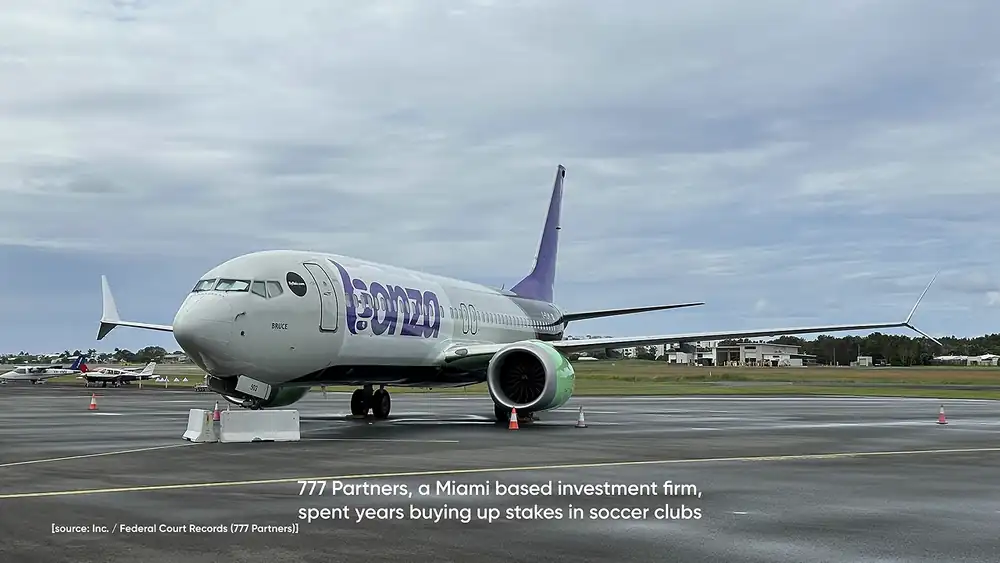
Bonza, launched in January 2023 and backed solely by Miami firm 777 Partners, planned 38 routes across 21 mostly regional Australian destinations. Prosecutors later alleged that co-founder Josh Wander pledged assets the firm did not own or had already pledged, totaling more than 350 million dollars, and he was indicted in October 2025 over an alleged 500 million dollar scheme.
Cheap fares on untested routes need a deep cushion, and Bonza’s backer had far less than it appeared.
Chapter 2: The law that built the whole industry
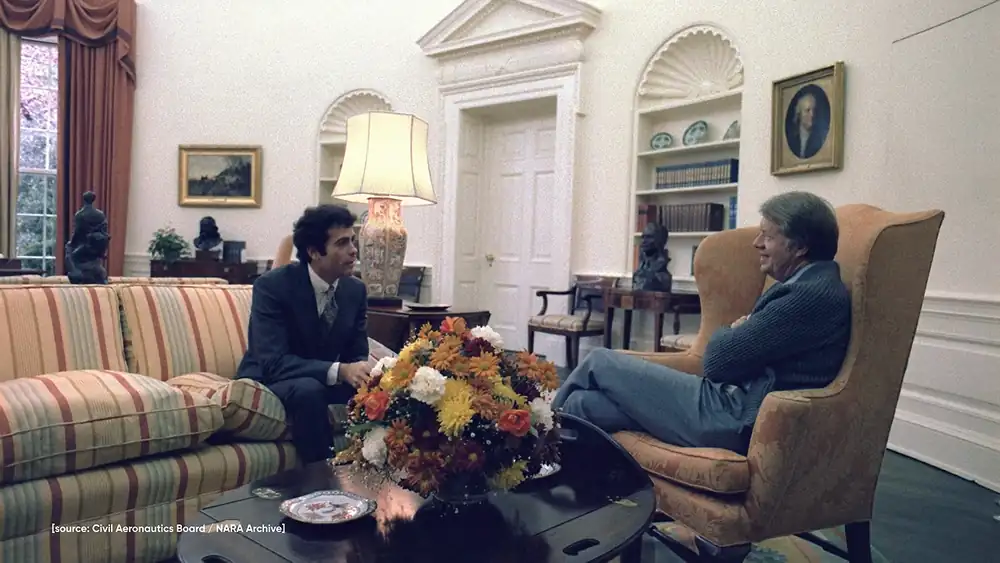
Before 1978, a federal agency called the Civil Aeronautics Board approved every US fare and route. New routes took years, new airlines barely existed, and a handful of carriers such as American, United, TWA and Pan Am kept fares high. Jimmy Carter signed the Airline Deregulation Act on October 24, 1978, after appointing economist Alfred Kahn to chair the board, which Kahn then argued out of existence.
Fares fell and kept falling: adjusted for inflation, the real price of flying in the US dropped nearly 45% between 1978 and 2011. A 1986 study put the yearly benefit to travelers at roughly 8.5 billion dollars in that era’s money.
Deregulation also let airlines fail. Braniff collapsed in 1982, Pan Am shut in 1991 and TWA folded into American in 2001. Since 2000, every major US legacy carrier except Alaska Airlines has filed for bankruptcy at least once, and smaller communities lost frequency while average fares dropped elsewhere.
Southwest, founded in 1967 by Herb Kelleher and Rollin King, had dodged federal control by flying only inside Texas. After 1978 it crossed state lines and built the low-cost, point to point model that budget airlines everywhere have copied since.
The 1978 law created the freedom to launch a cheap airline fast and removed every safety net under it.
Chapter 3: The leasing secret

By early 2024, 53% of the world’s commercial fleet was leased rather than owned by the airline flying it. Leasing works like a family leasing a car: a narrowbody can list for well over a hundred million dollars, and monthly payments free cash for fuel, payroll and insurance. Many carriers also buy a jet and sell it to a lessor within weeks, then lease it back, as Lufthansa did in a deal worth more than 400 million dollars in 2024.
The largest lessor is AerCap. Buying ILFC from AIG in 2014 added over 1,300 aircraft and 43 billion dollars in assets, and in 2021 it absorbed GE’s leasing arm in a package GE valued at more than 30 billion dollars. For 2025 AerCap reported 8.5 billion dollars in revenue and 3.8 billion in profit, a far fatter margin than the airlines paying it rent.
Lessors price risk like a mortgage lender. A new airline with one cash-strapped backer gets bigger deposits and tighter terms. Research also found leased jets change hands about 38% faster than owned ones and fly about 6.5% more hours, because lessors move aircraft away from struggling operators quickly.
Bonza’s six 737 MAX 8s were never its own. The Russian case shows the flip side: after the 2022 invasion of Ukraine, Russia kept more than 500 Western-leased jets worth 10 to 15 billion dollars. AerCap lost 116 aircraft and won just over 1 billion dollars from its war risk insurers in London’s High Court in June 2025.
A lease is only as strong as the legal system behind it, and outside a war zone that system sides with the owner.
Chapter 4: Two companies, every plane
Boeing and Airbus build essentially every large commercial jet, and CFM International, a GE and Safran venture, powers most 737 and A320 family aircraft with more than 37,500 engines delivered. The sticker price is fiction: Boeing’s last published 737 MAX 8 price was 121.6 million dollars, discounts of 40 to 60% are standard, and appraisers valued a new one closer to 55 million by mid 2025.
Even a duopoly competes hard. One study found markups on individual models fell from about 36% in the early 1970s to about 15% by the late 1990s. Size buys better deals, which is why small airlines lease through giants like AerCap. When delivery delays hit in 2024 and 2025, timing beat scale, and a used jet available now became the thing everyone wanted, leaving struggling carriers with even less bargaining room.
Hidden costs pile up in every fare. Insurance prices a new airline on a new type like a teenager with a first sports car. Runway access has a price too: in 2017 American Airlines paid SAS 75 million dollars for one pair of morning slots at Heathrow. Research on a 2000 US law that freed slots found fares fell roughly 20% where incumbents had to release them.
On one day in June 2025, a record 24,115 aircraft were airborne at the same moment, every one tracing back to two production lines.
Two manufacturers set the price of every jet, and a bottleneck at either one ripples through every lease.
Chapter 5: The math that never quite works
Fuel can eat close to a third of an airline’s operating costs. Depreciation and leases add about a tenth, and crew roughly another tenth. After many experienced captains retired early in the pandemic, pilot pay climbed: Delta pilots ratified 34% raises over four years in March 2023, and some United raises reached 40%. Research on the decade after 1978 found pilot earnings fell from about 75% above comparable jobs to about 61%, so the new deals look like lost ground being clawed back.
Those costs barely move with ticket sales. The pilot, gate rent and lease cost the same on a full or a half-empty plane, which is why load factor, the share of seats filled, obsesses executives. A flight at 70% full can be solidly profitable while the same flight at 60% bleeds cash. Industry load factor sat barely above 50% in the early 1970s and reached 83% by 2011.
Airlines crossed one trillion dollars in revenue in 2025, about 32,000 dollars a second, on a 4.2% margin. Then conflict in the Middle East and a roughly 70% jump in jet fuel cut the 2026 forecast margin from 3.9% to 2.0%, and expected profit from 41 billion to about 23 billion dollars. Two cents per dollar means roughly four dollars kept from a 200 dollar ticket.
Ten empty rows can be the whole distance between an airline that survives the year and one that does not.
Chapter 6: The fees you didn’t used to pay
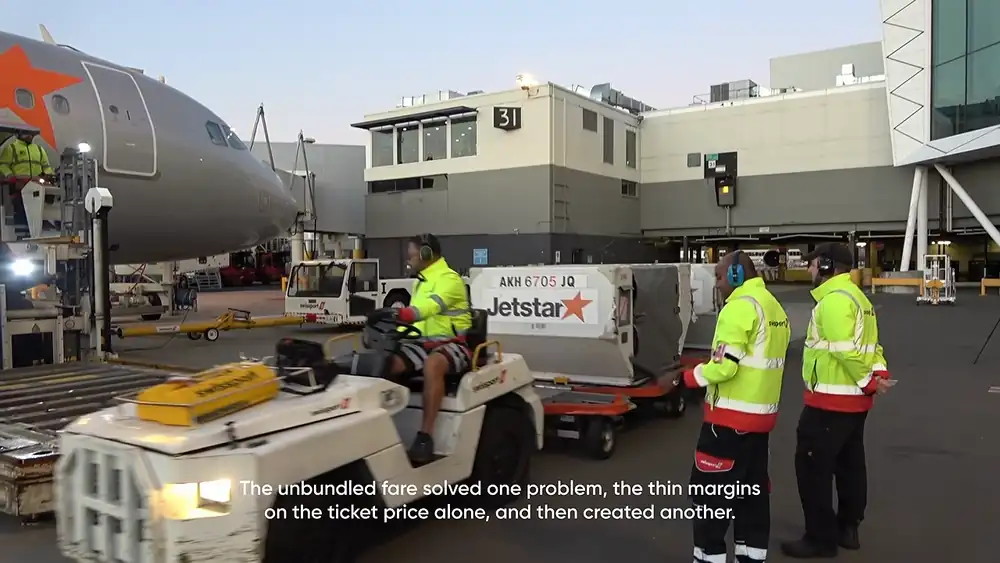
Thin margins had nothing to do with a lack of customers. A record 4.9 billion people flew in 2024, and load factor hit 83.6% in 2025. Full planes still were not paying the bills, so airlines went after money outside the ticket.
Ryanair, shaped by Michael O’Leary, prices nearly everything separately, from bags and seats to printing a boarding pass at the airport. In the year to March 2025 it took 13.95 billion euros in revenue, with 4.72 billion euros, roughly a third, coming from extras. A 2017 US government report found bag and change fees grew from 6.3 billion dollars in 2010 to 7.1 billion in 2016, and that travelers paying for bags usually spent more overall than under the old bundled fares.
Spirit built its business on the same unbundling and grew fast, yet its stripped-down fare left no cushion. It filed for Chapter 11 in November 2024 and again in August 2025.
The trick behind it is psychology. In one study, when a low base price came first and fees were added step by step, 94% of shoppers picked the option with the higher final total. Shown the full price upfront, only 19% did.
Fees can patch a thin margin, though they cannot cover a fuel bill that doubles overnight.
Chapter 7: The fuel gamble
Three airlines made three different bets on a commodity none of them controls. Southwest, under then finance chief Gary Kelly, started hedging in 1994, locking in a price now for fuel bought months later. By the end of 2000 it covered effectively all its fuel, and between 1998 and 2008 it saved an estimated 3.5 billion dollars. In the 2008 spike it bought roughly 70% of its fuel near 51 dollars a barrel while rivals paid 130.
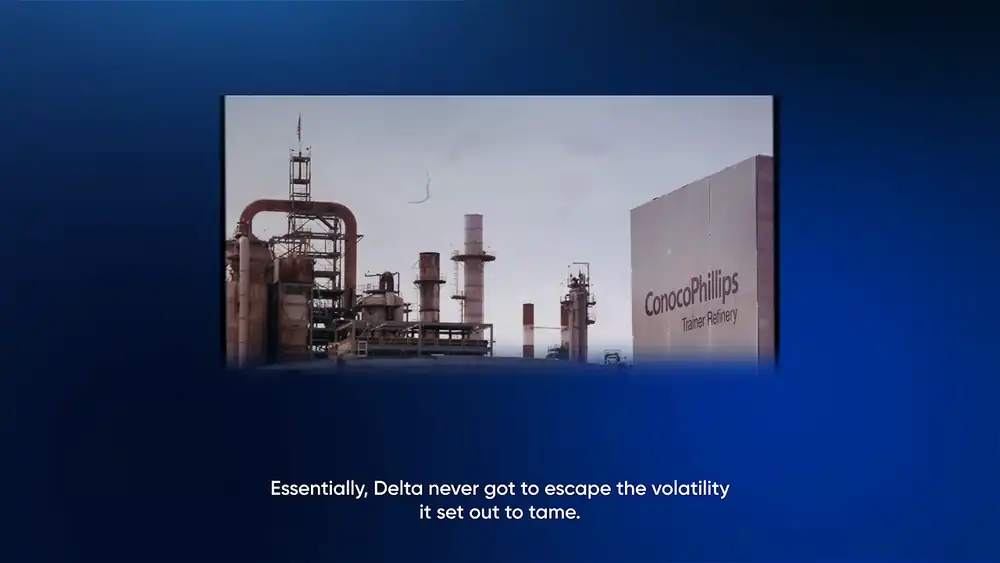
Delta tried to own the source. With fuel at 12.2 billion dollars a year, 36% of its operating budget, a Delta subsidiary paid 180 million dollars for the Trainer refinery in Pennsylvania in 2012. Refinery results swung from a 116 million dollar loss in 2013 to a 290 million profit in 2015 and a 125 million loss in 2016, so the volatility simply moved address.
WOW Air skipped hedging entirely. Jet fuel rose from about 93 cents a gallon in 2016 to 2.25 dollars by September 2018, just as founder Skuli Mogensen added three A330 widebodies. His personal 5.5 million euro injection bought weeks, and the airline collapsed in March 2019.
A 2006 study found airlines that hedged fuel carried values roughly 26% higher than those that did not.
The real decision is which risk an airline can survive being wrong about.
Chapter 8: A pattern, not an accident
A 2005 US government report counted 162 airline bankruptcy filings since 1978. Of 148 Chapter 11 cases reviewed, only 18 airlines still held an operating certificate years later, and the report called the problem endemic to the industry.
The list keeps going. Monarch collapsed on October 2, 2017, stranding about 110,000 passengers abroad and prompting what officials called the largest peacetime repatriation in UK history. Flybe was rescued in 2019 and again in January 2020, then failed on March 5, 2020, costing more than 2,000 jobs. Alitalia shut on October 15, 2021, and reappeared within weeks as ITA Airways. Norwegian survived court restructuring, shrinking from 156 aircraft to 51 and from about 10,200 staff to about 3,300 after lenders wrote off 63 to 65 billion kroner.
Virgin Australia shows the difference a backer makes. After the government refused a 1.4 billion dollar emergency loan in April 2020, Bain Capital bought it in a deal near 3.5 billion Australian dollars and kept the brand flying. The whole industry lost 126.4 billion dollars that year as passengers fell 60.2%.
Bonza, by contrast, owed roughly 116 million Australian dollars when it failed, left nearly 58,000 customers with dead bookings and 323 staff without jobs. Whether you get your fare back usually depends on payment method: credit card buyers can often dispute the charge, while others join the queue of unsecured creditors.
The crisis explains little; who stands behind the airline when it hits explains almost everything.
Chapter 9: The forty-eight hours

By April 2024, Bonza was running on a single backer’s patience and a fleet smaller than planned, while 777 Partners struggled to meet obligations across its portfolio of soccer clubs, streaming platforms and the Australian airline that depended on it completely.
On the night of April 29, at 11:51 PM, the lessor moved to repossess Bonza’s 737 MAX 8 jets. By the morning of April 30, every flight for the following week was cancelled. The airline entered voluntary administration that day, and many of its 323 staff learned they were out of work from the news.
Qantas, Virgin Australia and Jetstar offered discounted or free flights to stranded travelers within days, an unusual show of mercy between rivals. By early May the first jet had left Australian airspace for the global leasing pool. Small trade creditors such as regional caterers and ground handlers found themselves behind lenders and airports in the queue.
Bonza was liquidated on July 2, 2024, roughly eighteen months after its first flight. In October 2025, the man behind the firm that bankrolled it was in federal court facing fraud charges.
A missed payment at 11:51 PM was enough to ground an entire airline before sunrise.
Conclusion: The mechanism
Aviation supports an estimated 4.1 trillion dollars in global economic activity and 86.5 million jobs on top of a remarkably thin base.
The scale gap is striking. AerCap owns and manages roughly 1,589 planes, more than Ryanair, easyJet and Wizz Air combined at about 1,250. Research on US bankruptcies since 1984 found rivals absorb most of a failed carrier’s routes within weeks, so the market recovers fast even when the passenger holding a dead ticket does not.
Bonza’s jet, the same type grounded for 619 days five years earlier, was flying again within weeks for another airline. The plane turned out to be the one part of the bet that never failed.
What sits under a 200 dollar fare
Airlines make something true across much of business easy to see: the asset in front of you is rarely the whole picture, and the company holding it together is often thinner than it looks from the customer’s side of the counter.
The next time a cheap flight makes you wonder how the maths works, remember what is underneath it: a machine the airline does not own, a safety certificate partly signed by its builder, fuel nobody can predict and a margin so thin that one bad quarter can end a carrier that looked exactly like every other one.
FAQ
Do airlines own their planes?
Most do not. By early 2024, 53% of the world’s commercial fleet was leased from companies such as AerCap rather than owned by the airline flying it.
How much profit does an airline make per ticket?
Very little. With the 2026 industry margin forecast cut to 2.0%, an airline keeps roughly four dollars from a 200 dollar ticket.
Why do so many airlines go bankrupt?
Costs like pilots, leases and gate fees stay the same whether planes fly full or half empty, margins are thin and fuel swings wildly. A 2005 US government report counted 162 airline bankruptcy filings since 1978 and called the problem endemic.
What happened to Bonza airline?
On the night of April 29, 2024, Bonza’s lessor moved to repossess its 737 MAX 8 jets, and all flights were cancelled by the next morning. It entered voluntary administration that day, left nearly 58,000 customers with dead bookings and was liquidated on July 2, 2024.
What is airline fuel hedging?
Hedging means locking in a price today for fuel you will buy months later. Southwest saved an estimated 3.5 billion dollars this way between 1998 and 2008, buying fuel near 51 dollars a barrel in 2008 while rivals paid 130.
How do airlines make money from fees?
They sell a bare base fare and charge separately for bags, seats and boarding. Ryanair earned 4.72 billion euros, roughly a third of its revenue, from these extras in the year to March 2025.
Keep reading