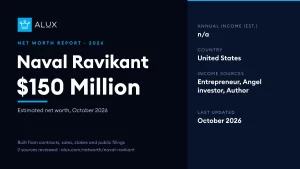
Naval Ravikant
- Net worth $150 million
- Birthday November 5, 1974
- Status -
- Country United States
- Source(-s) of wealth Entrepreneur, Investor
How much is Naval Ravikant Worth? Naval Ravikant Net Worth in 2026
Naval Ravikant’s net worth is estimated at $150 million as of October 2026. Ravikant is an Indian-born American entrepreneur, angel investor and thinker on wealth and happiness. Nearly all of the money comes from startup equity, chiefly his stake in AngelList, which he co-founded, plus early investments in companies such as Uber and Twitter.
| Net worth | $150 million (estimate) |
|---|---|
| Born | November 5, 1974, New Delhi, India (age 51) |
| Country | United States |
| Known for | Co-founding AngelList, early startup investing, and The Almanack of Naval Ravikant |
| Main income sources | Startup equity, angel investments, venture fund returns, crypto-related funds |
| Estimated annual income | Not publicly reported; wealth is mostly illiquid equity |
How much is Naval Ravikant worth in 2026?
Our estimate for Naval Ravikant is about $150 million. It is an estimate, not a reported figure, because most of his holdings are private shares and he does not publish his finances. Public guesses range from roughly $60 million to well over $300 million, and the spread comes from how much of AngelList he still owns and how his early positions in Uber and Twitter are valued. AngelList’s venture arm raised money at a $4 billion valuation in 2022, and a 2007 fund he started backed Twitter, Uber and Stack Overflow. We place the figure in the middle to upper part of the range because those early bets were made at very low prices.
How Naval Ravikant built it
- Co-founded AngelList. He remains chairman and holds a stake in it.
- Invested early in startups. His early bets include Uber and Twitter.
- Backed other founders. In 2017 he launched Spearhead, which gives founders capital to invest as angels.
Learn the wealth mindset behind Naval Ravikant’s career in the Alux app.
Get the Alux appNaval Ravikant in 2026: what they have been working on
- 2026: Named to a 2026 list of top self-made American entrepreneurs, according to a biography page that cites the list.
- 2023: Co-founded Airchat, a social app built around short voice notes that are transcribed by AI.
- 2022: AngelList Venture raised funds at a reported $4 billion valuation. Ravikant remains chairman of AngelList.
- Ongoing: Spearhead, a program he launched in 2017 that gives founders capital to invest as angels. Its third cohort reportedly raised $100 million for 15 founders.
- Ongoing: Writes and speaks about wealth, judgment and happiness on his own site and podcast. The Almanack of Naval Ravikant, compiled by Eric Jorgenson, collects this material.
How Naval Ravikant makes money
- Startup equity: His stake in AngelList, which also runs Product Hunt. This is the largest and least visible part of his wealth.
- Angel investments: Early positions in Uber, Twitter, Postmates and Yammer, plus later bets through Spearhead-backed companies such as Neuralink, Opendoor and Rippling.
- Venture funds: Returns from The Hit Forge, a $20 million early-stage fund started around 2007, and from fund interests since.
- Crypto funds: MetaStable Capital, a crypto hedge fund he co-founded in 2014, reported $69 million in assets in a 2017 filing. The size of his own share is not public.
- Earlier exits: Epinions, which he co-founded in 1999, merged into Shopping.com, which went public in 2004.
- Books and media: Minor. The Almanack was designed to be free to read online, so it is not a main income source.
What Naval Ravikant teaches (and what to take from it)
Ravikant is known for short, dense ideas about how to build wealth without being owned by a job, and how to stay calm while doing it. Here are four we find practical.
Own a piece of what you build
Ravikant argues that a salary caps your upside, while equity lets your work keep paying after you stop. The point is ownership, not hustle for its own sake.
This week: List the three things you do at work that create the most value, then write down one way each could earn you a share, a royalty or a product of your own.
Build specific knowledge
He describes specific knowledge as skill that cannot be handed over in a training course, because it comes from following your own curiosity deeply. It tends to look like play to you and like work to everyone else.
Try it: Write down what you do that others find hard but you find natural. Spend two hours on it before Friday, even if no one asked you to.
Multiply your output
Code, media and capital let one person’s output reach many people without more hours. Ravikant sees publishing and software as the modern route to wealth, since neither needs anyone’s permission.
Practice: Publish one useful thing: a short post, a template or a small tool. Treat it as a first rep, not a finished product.
Treat happiness as a skill
He frames desire as a deal you make with yourself to be unhappy until you get the thing. Peace, in his view, comes from wanting less and choosing fewer fights.
Start small: Next time you want to buy or chase something, write the want down and wait 24 hours before acting on it. Notice how many fade.
Career timeline
- 1974: Born in New Delhi, India.
- 1995: Graduates from Dartmouth College in computer science and economics.
- 1999: Co-founds Epinions, a product review site that raised $45 million in venture capital.
- 2004: Shopping.com, formed from the Epinions merger, goes public.
- 2007: Starts The Hit Forge, an early-stage fund that backed Twitter, Uber and Stack Overflow.
- 2010: Co-founds AngelList, which grew out of the Venture Hacks blog.
- 2014: Co-founds MetaStable Capital, a crypto hedge fund.
- 2017: Launches Spearhead to help founders become angel investors.
- 2020: The Almanack of Naval Ravikant is published.
- 2023: Co-founds Airchat.
Early life and background
Naval Ravikant was born in New Delhi, India, and moved to New York City with his mother and brother at age 9. He attended Stuyvesant High School, graduating in 1991, and then Dartmouth College, where he studied computer science and economics and graduated in 1995. He worked briefly at a consulting firm before moving to Silicon Valley, where he began his career as a startup founder.
Naval Ravikant net worth FAQ
What is Naval Ravikant’s net worth?
Naval Ravikant’s net worth is estimated at $150 million as of October 2026. It is an estimate because most of his wealth is in private company shares.
How does Naval Ravikant make money?
Mostly through startup equity and angel investing, including his stake in AngelList and early investments in companies such as Uber and Twitter. Fund returns add to that.
How old is Naval Ravikant?
Naval Ravikant was born on November 5, 1974, so he is 51 as of October 2026.
What is Naval Ravikant known for?
He co-founded AngelList and is known for early startup investing and for widely shared ideas about wealth and happiness.
What is Naval Ravikant’s best-known book?
The Almanack of Naval Ravikant, published in 2020. It was compiled by Eric Jorgenson from Ravikant’s tweets, essays and interviews.
How is Naval Ravikant’s net worth estimated?
We combine reported valuations of AngelList, the known early investments, and fund disclosures, then adjust for the fact that holdings are private. The result is an approximation.
Related profiles
How we estimate net worth
Our estimates are based on public reporting, company valuations, and deal and earnings figures all compiled in an internal valuation model. They are approximate, and figures change over time as new information emerges.
Last updated: October 2026.