The richest young billionaire in the world as of November 2026 is OpenAI cofounder Greg Brockman, 38, with an estimated net worth of about $25.5 billion. This ranking covers living, self-made billionaires who were under 40 in November 2026. Heirs who are younger and sometimes richer, like the Red Bull heir and the Luxottica grandsons, appear in the special mentions at the end, because they did not build the fortune themselves.
| Rank | Name | Net worth (USD) | Main source of wealth |
|---|---|---|---|
| 10 | Wang Ning (39) | $11.8 billion | Pop Mart |
| 9 | Sam McCandlish (36) | $13.7 billion | Anthropic |
| 8 | Daniela Amodei (39) | $14.2 billion | Anthropic |
| 7 | Jack Clark (37) | $14.3 billion | Anthropic |
| 6 | Chris Olah (34) | $14.3 billion | Anthropic |
| 5 | Tom Brown (39) | $14.4 billion | Anthropic |
| 4 | John Collison (36) | $17.5 billion | Stripe |
| 3 | Patrick Collison (38) | $17.5 billion | Stripe |
| 2 | Edwin Chen (38) | $18 billion | Surge AI |
| 1 | Greg Brockman (38) | $25.5 billion | OpenAI |
10. Wang Ning: $11.8 billion
Wang Ning is the only person in this top 10 who got rich selling something you can hold. He opened a small variety store in Beijing’s Zhongguancun tech district in 2010, noticed that one brand of collectible figures sold far better than everything else, and rebuilt the business around blind boxes: sealed packages where you do not know which toy you are getting until you open it.
That store became Pop Mart, which listed in Hong Kong in December 2020. Then came Labubu, a toothy little monster that turned into a global craze in 2024 and 2025, with lines outside stores from Bangkok to London. The stock soared, and Wang briefly had a fortune of more than $20 billion before shares cooled. He turns 40 in 2027, so this is his last year on the list.
His figure comes from his Pop Mart stake at the Hong Kong share price in November 2026.
9. Sam McCandlish: $13.7 billion
Sam McCandlish trained as a theoretical physicist, earning a PhD at Stanford, before he moved into AI research. At OpenAI he worked on the scaling research that showed how language models predictably improve as they get bigger, the insight behind the whole current AI boom.
In 2021 he left with six colleagues to cofound Anthropic, the company behind the Claude AI models, where he is chief architect. Anthropic raised money at a $965 billion valuation in May 2026 and filed for a Nasdaq listing on October 26, 2026, with Wall Street estimates for the offering running as high as $2 trillion. Like his cofounders, McCandlish has pledged to give away 80% of his Anthropic equity.
We multiplied his roughly 232 million shares by the price of Anthropic’s last private funding round.
8. Daniela Amodei: $14.2 billion
Daniela Amodei studied English literature and music, worked in global health, then joined Stripe in its early days, where she spent five years building teams. She moved to OpenAI to lead safety and policy work, and in 2021 she and her brother Dario walked out together to start Anthropic.
She is Anthropic’s president and chair of its board. Dario runs the research and product side as CEO, while Daniela runs the business, which grew faster in 2025 and 2026 than almost any software company in history. She is 39 and one of the few women on any list of the world’s richest self-made people under 40.
The total uses her roughly 241 million shares at Anthropic’s latest private price.
7. Jack Clark: $14.3 billion
Jack Clark is a Brit who started out as a technology journalist, writing about AI before most people took it seriously. He joined OpenAI as policy director in 2016 and started Import AI, a weekly newsletter on AI research that he still writes.
At Anthropic he leads the company’s public benefit work and its research institute, which studies how AI affects jobs and the economy. He is also one of the industry’s best-known explainers of where AI research is heading.
Clark’s number reflects about 242 million Anthropic shares, valued at the most recent round.
6. Chris Olah: $14.3 billion
Chris Olah never finished a university degree. He left the University of Toronto, received a Thiel Fellowship and went on to do research at Google Brain and OpenAI, where his blog posts explaining how neural networks see images became required reading for a generation of AI engineers.
At 34, he is the youngest Anthropic cofounder and leads its interpretability research, the work of figuring out what is actually happening inside an AI model. Few people have become billionaires by studying how a product thinks rather than by selling it.
His stake, roughly 243 million shares, is valued at Anthropic’s last private share price.
5. Tom Brown: $14.4 billion
Tom Brown was the lead author of the 2020 paper that introduced GPT-3, the model that first convinced the tech industry that large language models were going to matter. He had stints at startups and at Google Brain before joining OpenAI.
He is now Anthropic’s chief compute officer, which means he is in charge of the enormous chip and data center deals that let the company train its models. With about 244 million shares, he holds the largest stake of the seven cofounders, by a narrow margin.
Brown’s estimate puts those shares at the last private round’s price. If the IPO lands near the $2 trillion some analysts have floated, it would roughly double.
4. John Collison: $17.5 billion
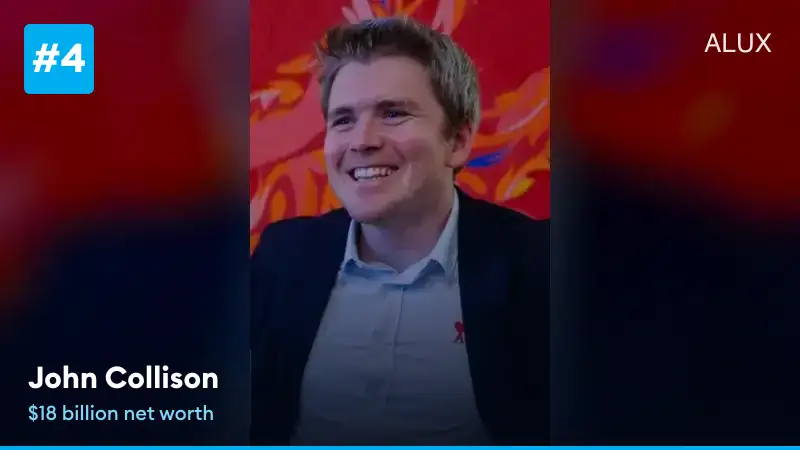
John Collison grew up in rural Ireland and sold his first startup, Auctomatic, with his brother before he was 18. In 2010 the pair started Stripe, a few lines of code that let any website accept card payments. In 2016, at 26, he became the youngest self-made billionaire in the world.
He is Stripe’s president. The company has stayed private far longer than anyone expected, and in a February 2026 tender offer it was valued at $159 billion. Stripe processed more than $1.9 trillion in payments in 2025, about 1.6% of world GDP. You can read more on his John Collison net worth page.
We value his stake, estimated at about 11% of Stripe, at the 2026 tender price.
3. Patrick Collison: $17.5 billion
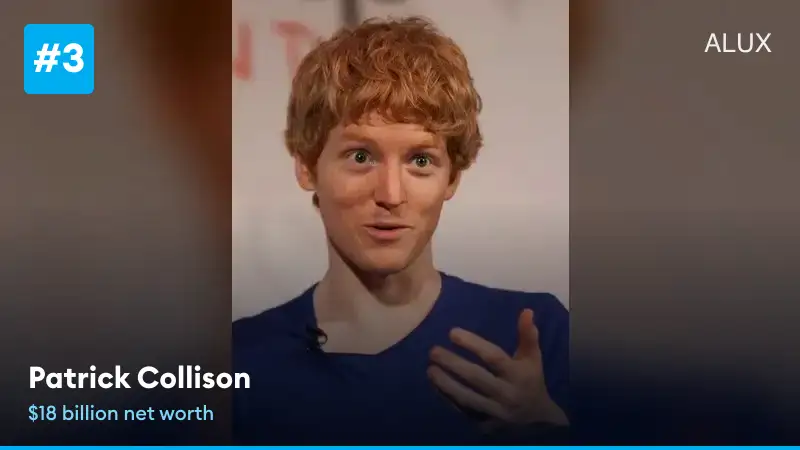
Patrick Collison, the older brother by two years, won Ireland’s top young scientist award as a teenager for a programming language he built. He left MIT after a year, and Stripe has been his only real job since.
As CEO, Patrick Collison has steered Stripe into stablecoins, AI agent payments and billing software, and he is one of the most widely read people in Silicon Valley. He also cofounded the Arc Institute, a biomedical research nonprofit, and invests in projects on scientific progress. He and his brother own roughly equal stakes.
The calculation mirrors his brother’s: an estimated 11% of Stripe at $159 billion.
2. Edwin Chen: $18 billion
Edwin Chen built one of the most profitable AI companies in the world without taking a dollar from investors. A former machine learning engineer at Google, Facebook and Twitter, he founded Surge AI in 2020 to supply the high-quality human feedback that AI labs need to train their models.
Surge reportedly passed $1 billion in revenue in 2024, with a small team, and Chen is believed to own about 75% of it. In 2025 the company explored a first outside fundraise at a valuation of $15 billion to $25 billion, which turned him from an unknown founder into one of the richest people in tech almost overnight. With no priced round made public since, his figure carries a wide margin.
Our model takes 75% of Surge at about $24 billion, the upper part of the range investors discussed.
1. Greg Brockman: $25.5 billion
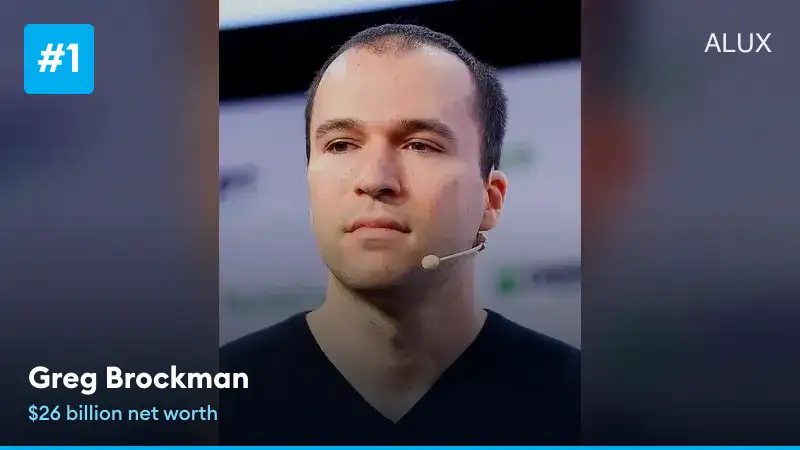
Greg Brockman left MIT in 2010 to join Stripe as one of its first employees and became its CTO. By the time he left, the company had grown from a handful of people to about 200. In 2015 he left to cofound OpenAI with Sam Altman and others, and he is now its president.
In May 2026 Brockman agreed in court testimony that his OpenAI stake was worth close to $30 billion, a number nobody outside the company had known. We estimate his net worth a little lower, at about $25.5 billion, because private shares are hard to sell and the price could move before any listing. He turns 39 at the end of November 2026, so he has room to stay at the top of this list for a while.
Our number values his estimated OpenAI stake at the company’s most recent private valuation.
Special mentions
These young billionaires inherited their fortunes, and the richest of them would top the ranking above.
- Mark Mateschitz (34): worth an estimated $40 billion or more from his inherited 49% stake in Red Bull.
- Clemente and Luca Del Vecchio (22 and 25): each worth an estimated $6 billion to $7 billion through the family’s stake in eyewear maker EssilorLuxottica.
What the richest young billionaires have in common
- AI made nine of the ten. Every name except Wang Ning got rich from AI or from software built for it, and eight of them came out of OpenAI or Stripe.
- Two companies trained most of the list. Brockman and Daniela Amodei came from Stripe, and the five Anthropic cofounders came from OpenAI. Talent networks, not garages, produced these fortunes.
- Almost all of it is paper. OpenAI, Anthropic, Stripe and Surge are private, so nine of these ten fortunes depend on funding-round prices. An IPO or a down round could reshuffle the order fast.
- Researchers got rich, not only CEOs. Olah, McCandlish and Brown are scientists by training. Owning a slice of the right lab early paid more than running it.
The habits that let people afford this
Short audio lessons on money, mindset and discipline, in the Alux app.
Get the Alux app →FAQ
Who is the richest young billionaire in the world?
Greg Brockman, the 38-year-old cofounder and president of OpenAI, is the richest self-made billionaire under 40, with an estimated net worth of about $25.5 billion as of November 2026.
What age counts as a young billionaire on this list?
We include living, self-made billionaires who were under 40 in November 2026. Heirs are listed separately as special mentions.
Who is the youngest self-made billionaire?
Surya Midha, cofounder of the AI hiring startup Mercor, became the youngest self-made billionaire on record when he crossed the line at 22 in 2025. His cofounders Brendan Foody and Adarsh Hiremath are the same age.
How much do you need to make the top 10?
Wang Ning is number 10 with about $11.8 billion. Robinhood cofounder Vlad Tenev, at roughly $7 billion, is among those just below the cut.
Why are there so many Anthropic cofounders on the list?
Anthropic’s seven cofounders each own a similar stake, about 240 million shares. Five of them are under 40, and at the company’s 2026 valuation each stake is worth roughly $14 billion.
Is Mark Zuckerberg still a young billionaire?
No. Mark Zuckerberg turned 42 in 2026, so he is past our under-40 cutoff.
How we estimate net worth
Our estimates are based on public reporting, company valuations, and deal and earnings figures all compiled in an internal valuation model. They are approximate, and figures change over time as new information emerges.
Keep reading
- How the AI gold rush is making people rich
- The most common ways to become a self-made billionaire
- Are we in an AI bubble
- Life-changing decisions self-made billionaires had to make
Last updated: November 2026.