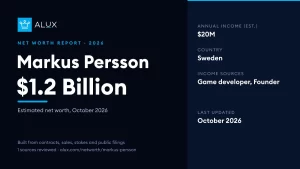
Markus Persson
- Net worth $1.2 billion
- Birthday June 1, 1979
- Status -
- Country Sweden
- Source(-s) of wealth Entrepreneur, Programmer
How much is Markus Persson Worth? Markus Persson Net Worth in 2026
Markus Persson’s net worth is estimated at $1.2 billion as of November 2026. The Swedish programmer known as Notch wrote the first version of Minecraft alone, then sold his 71 percent of Mojang to Microsoft in 2014. One game, one deal, and a very large tax bill explain nearly everything.
| Net worth | $1.2 billion (our estimate, range $1.0 to $1.4 billion) |
|---|---|
| Born | 1 June 1979, Stockholm, Sweden |
| Country | Sweden |
| Known for | Creating Minecraft and founding Mojang |
| Main income sources | Sale of Mojang shares, pre-sale dividends, investment returns |
| Estimated annual income | Not disclosed |
How much is Markus Persson worth in 2026?
We put Persson’s net worth at about $1.2 billion. That is lower than the headline price of the deal that made him rich, and the gap is the point of this page. Microsoft paid $2.5 billion for all of Mojang, but Persson owned 71 percent of the company when he sold to Microsoft in 2014, and Sweden taxes capital gains. Public estimates cluster around $1.2 billion to $1.3 billion, and any higher ones tend to count the whole sale price, or ignore tax, or both. This one is a rough estimate: little of his money since 2014 is documented, so the later years rest on assumptions we state below.
How Markus Persson built it
- Built the first version alone. Persson wrote the early Minecraft himself before Mojang had a team, then sold a 71 percent stake for $1.78 billion.
- Kept most of the company. At the 2014 offer he still held 71 percent of Mojang, which is why the sale price translated into personal wealth.
- Paid staff from the profits. He gave $3 million in dividends to Mojang employees in 2011, years before the sale.
Learn the wealth mindset behind Markus Persson’s career in the Alux app.
Get the Alux appHow we got to $1.2 billion
The documented money sits at the top. Everything below the sale price is either reported or a plain assumption, marked as such.
| Source | Our estimate | What it rests on |
|---|---|---|
| Mojang shares sold | $1.78 billion | 71 percent of a reported $2.5 billion sale to Microsoft in September 2014 |
| Dividends before the sale | $0.1 billion | A 2014 Financial Post report, cited on his Wikipedia page, said he had collected more than $100 million in dividends since 2011 |
| Tax on the sale | minus $0.53 billion | Assumption: Sweden’s 30 percent rate on the sale price, with no cost basis to subtract |
| Spending, giving and failed projects | minus $0.15 billion | Includes a $70 million Beverly Hills house bought in December 2014 and SEK 60 million spent by his later studio without a release by 2021 |
Total: $1.78 billion + $0.1 billion minus $0.53 billion minus $0.15 billion = $1.2 billion. We assume the leftover cash has roughly held its value since 2014, so we add no investment gains and no investment income. That choice makes the figure conservative.
Nineteen years of profit in one cheque
According to his Wikipedia entry, Mojang reported 2013 revenue of $330 million and profit of $129 million. Persson’s 71 percent of that profit was about $91.6 million. Our calculation: $1.78 billion ÷ $91.6 million is roughly 19, so Microsoft’s payment equalled about 19 years of his share of the best profit year the company had ever posted. Buyers usually pay for growth, and in 2014 Minecraft looked like it still had plenty.
The house that set a record
Within months of the sale, Persson bought a home in Trousdale Estates, Beverly Hills, for $70 million, a record price for Beverly Hills at the time. It is the biggest single purchase we can document, and it equals about 6 percent of his after-tax proceeds in our ledger. The rest of the spending line is smaller and mostly guesswork, so we keep it modest.
Giving back before the money arrived
In 2011 he handed $3 million in dividends to Mojang employees, and in 2012 he gave $250,000 to the Electronic Frontier Foundation. A Humble Indie Bundle game from the studio raised $458,248 for charity. None of these gifts changes the total by more than a rounding error.
What he has done since
His later studio, Rubberbrain, reportedly spent SEK 60 million without shipping a game, and it was relaunched as Bitshift Entertainment on 28 March 2024. In January 2025 he announced a spiritual successor to Minecraft, then chose to make a roguelike called Levers and Chests instead. That is the latest documented event we found, almost two years old, and we found no later fact about his money. If a game ships and sells, it would add to the figure, though even a good indie hit is small next to Mojang.
What would move the number
Almost nothing from the outside. The Mojang money is spent or sitting in assets, so only a hit game, a large investment gain or a documented tax settlement would shift our estimate by more than 10 percent.
Sources we read: Wikipedia entry on Markus Persson; Biography.com profile.
Markus Persson net worth FAQ
How much did Markus Persson make from selling Minecraft?
About $1.78 billion before tax, which is 71 percent of the reported $2.5 billion Microsoft paid for Mojang in 2014. Our estimate of what remained after tax and spending is about $1.2 billion.
How old is Markus Persson?
He was born on 1 June 1979 in Stockholm, so he is 47.
Why do other estimates of Notch’s wealth differ?
Some use the full $2.5 billion price, which ignores the other owners and the tax. Others are years old.
How much did Mojang earn before the sale?
The studio reported 2013 revenue of $330 million and profit of $129 million.
What is Markus Persson doing now?
He announced a game called Levers and Chests in January 2025 through Bitshift Entertainment, the relaunched version of his earlier studio.
How is Markus Persson’s net worth estimated?
We start from his 71 percent of the sale price, add known dividends, then subtract an assumed 30 percent tax and documented spending.
Related profiles
How we estimate net worth
Our estimates are based on public reporting, company valuations, and deal and earnings figures all compiled in an internal valuation model. They are approximate, and figures change over time as new information emerges.
Last updated: November 2026.