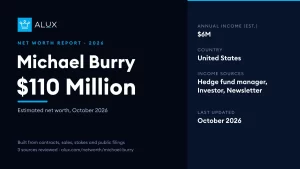
How much is Michael Burry Worth? Michael Burry Net Worth in 2026
Michael Burry’s net worth is estimated at $110 million as of November 2026, with a plausible range of $75 million to $200 million.
This one is a rough estimate: little of the money is documented. The single hard number is a $100 million personal profit from the 2008 housing short, a trade that made another $700 million for his investors, which means Burry himself took about one dollar in eight.
| Net worth | $110 million (rough estimate, range $75 million to $200 million) |
|---|---|
| Estimated annual income | Not disclosed; newsletter subscriptions are the only known current stream |
| Country | United States |
| Known for | Betting against subprime mortgages, the subject of The Big Short |
| Main income sources | Past trading gains, fees from Scion Asset Management, Cassandra Unchained newsletter |
How Michael Burry built it
- Read the loan documents. His 2008 housing short earned a reported $100 million personally and more than $700 million for investors.
- Started small with family money. Scion Capital was funded in 2000 by an inheritance and loans from his family.
- Closed the fund and went direct. He shut Scion in late 2025 and launched a $379 a year newsletter in November.
Learn the wealth mindset behind Michael Burry’s career in the Alux app.
Get the Alux appHow much is Michael Burry worth in 2026?
We put Michael Burry at about $110 million. Burry has never published a balance sheet, and he is not on the large billionaire lists. Public guesses of $200 million to $350 million exist, but we could find nothing in a filing or a quote to support a number that high.
A likely reason public guesses run higher is that they treat his $155 million fund and the roughly $1.1 billion of put options in its last public filing as if they were his own money. The fund held other people’s capital, and the options figure is the size of the bets, not what they cost or earned.
How we got to $110 million
| Source | Our estimate | What it rests on |
|---|---|---|
| 2008 housing short, personal profit | $65 million | A $100 million personal gain, as summarised on his Wikipedia page from a Vanity Fair article by Michael Lewis. We assume 35 percent went in tax, which leaves $65 million. |
| Growth on that money since 2008 | $26 million | An assumption. We let the $65 million grow at a net 2 percent a year after spending for 17 years, 2008 to 2025, a factor of 1.40. |
| Scion Asset Management fees, 2013 to 2025 | $15 million | The fund reported about $155 million in assets in March 2025. We have only one asset figure, so we assume 2 percent fees on roughly $150 million for 12 years, $36 million gross, and keep about 40 percent after costs and tax. The fund was reopened mainly to invest his own money, so this row may be too high. |
| Cassandra Unchained newsletter | $4 million | Priced at $379 a year at launch in November 2025. We assume 15,000 paying readers, $5.7 million a year before Substack’s cut and tax. This row rests on audience size and nothing else. |
The rows add to $110 million. Only the first row starts from a reported figure, and even that one needs our tax assumption. Everything else is assumption, and the $100 million itself is a figure repeated in press reports that has never been audited.
One dollar in eight
Our calculation: $100 million personal profit plus $700 million for investors is $800 million of gains. His $100 million is 12.5 percent of that, one dollar in eight. Investors, not Burry, collected most of the winnings from the most famous short in finance.
Scion Capital was started in 2000 with an inheritance and family loans and was shut in 2008, after an investor revolt. He reopened as Scion Asset Management in 2013, saying he wanted to invest personally in water, farmland and gold. No amounts have been disclosed.
The fund that closed in 2025
In November 2025 Hedgeweek reported, citing a letter to investors, that Burry was closing Scion, and that the firm was no longer registered with the SEC. Its last public filing showed put options on Nvidia and Palantir with a combined notional value of about $1.1 billion. Hedgeweek reported he spent about $9.2 million on 50,000 Palantir puts, which is the actual cost of that bet. Our calculation: $9.2 million is 5.9 percent of the $155 million the fund reported in March 2025, though the two numbers are from different dates.
He launched the newsletter the same month. In September 2026, Wikipedia’s account has him swapping several short positions for put options on Micron, Nebius, Palantir and a semiconductor ETF, with no amounts disclosed.
What would move the figure
Real-asset holdings, a disclosed fund payout or a published subscriber count would move this estimate more than any market call. A reported subscriber number of 30,000 would add about $4 million to the newsletter row. A single big win on the next short could add more, but he no longer runs outside money.
Michael Burry net worth FAQ
What is Michael Burry’s net worth?
Our rough estimate is $110 million as of November 2026, with a range of $75 million to $200 million. Little of his money is documented.
How much did Michael Burry make on The Big Short trade?
Reports said he made about $100 million personally and more than $700 million for his investors in 2008.
Did Michael Burry close his fund?
Yes. Reports in November 2025, citing a letter to investors, said Scion Asset Management was closing, and the firm is no longer registered with the SEC.
How much does Michael Burry’s newsletter cost?
Cassandra Unchained launched in November 2025 at $379 a year. Wikipedia now lists $439. The number of paying readers is not public.
How big was Michael Burry’s fund?
Scion reported about $155 million in assets in March 2025.
Is Michael Burry a billionaire?
No. He is not on the major billionaire lists, and nothing in public filings points to $1 billion.
Related profiles
How we estimate net worth
Our estimates are based on public reporting, company valuations, and deal and earnings figures all compiled in an internal valuation model. They are approximate, and figures change over time as new information emerges.
Last updated: November 2026.