Jensen Huang is the richest AI billionaire in the world as of November 2026, with a net worth we estimate at about $155 billion. This list ranks living people whose fortunes were built mainly by artificial intelligence: founders and leaders of AI chip makers, AI labs and AI software companies. Tech billionaires who got rich from something else first (search engines, social networks, databases, rockets) are in the special mentions, even when AI has pushed their fortunes higher.
The ranking leans heavily on private company prices, and those can move by hundreds of billions in a single funding round. Treat every figure below as a snapshot of early November 2026.
| Rank | Name | Net worth (USD) | Main source of wealth |
|---|---|---|---|
| 10 | Brendan Foody | $2.2 billion | Mercor |
| 9 | Alexandr Wang | $3.2 billion | Scale AI |
| 8 | Daniel Nadler | $8.5 billion | OpenEvidence |
| 7 | Alex Karp | $13 billion | Palantir |
| 6 | Daniela Amodei | $14.2 billion | Anthropic |
| 5 | Dario Amodei | $15.5 billion | Anthropic |
| 4 | Edwin Chen | $18 billion | Surge AI |
| 3 | Chen Tianshi | $23 billion | Cambricon Technologies |
| 2 | Liang Wenfeng | $42 billion | DeepSeek and High-Flyer |
| 1 | Jensen Huang | $155 billion | Nvidia |
The countdown
10. Brendan Foody: $2.2 billion
Brendan Foody met his co-founders Adarsh Hiremath and Surya Midha on the high school debate circuit in the Bay Area. In 2023 the three of them started Mercor, a hiring platform that uses AI to interview and match candidates. The business that took off was a different one: supplying doctors, lawyers, bankers and other experts to AI labs that need humans to grade and train their models.
Mercor raised money at a $10 billion valuation in late 2025, which made all three founders billionaires at 22, younger than any self-made billionaire before them. Foody runs the company as CEO.
His figure reflects a founder stake in Mercor at its $10 billion round, matching the roughly $2.2 billion credited to each of the three co-founders.
9. Alexandr Wang: $3.2 billion

Wang dropped out of MIT at 19 and started Scale AI in 2016 to label the data that self-driving cars needed. As language models arrived, Scale pivoted to producing the human feedback those models train on, and its customers included most of the big labs and the US Department of Defense.
In June 2025 Meta paid about $14.3 billion for 49% of Scale and hired Wang to lead its new superintelligence effort. He kept a stake in Scale, and that holding plus the cash from the deal account for most of his money. At 29 he is one of the most powerful people in AI research without having written its most famous papers.
We value his remaining Scale shares at the price Meta paid, which lands near our existing Alexandr Wang net worth figure of $3.2 billion.
8. Daniel Nadler: $8.5 billion
Nadler has already done this once. He co-founded Kensho, an AI tool for Wall Street analysts, and sold it to S&P Global for about $550 million in 2018. He also writes poetry and has published a collection, a detail that rarely appears in the biographies of AI founders.
His second act is OpenEvidence, a medical search engine that answers doctors’ questions with citations from peer-reviewed research. It is free for verified clinicians and paid for by advertising, and it spread through US hospitals at remarkable speed. Funding rounds through 2025 pushed its valuation into the billions, and Nadler owns a large share.
The estimate starts from a stake of about 56% in OpenEvidence, after dilution from later rounds, at the $15 billion valuation of its September 2026 funding round. Add what is left of his Kensho money and he comes to about $8.5 billion.
7. Alex Karp: $13 billion
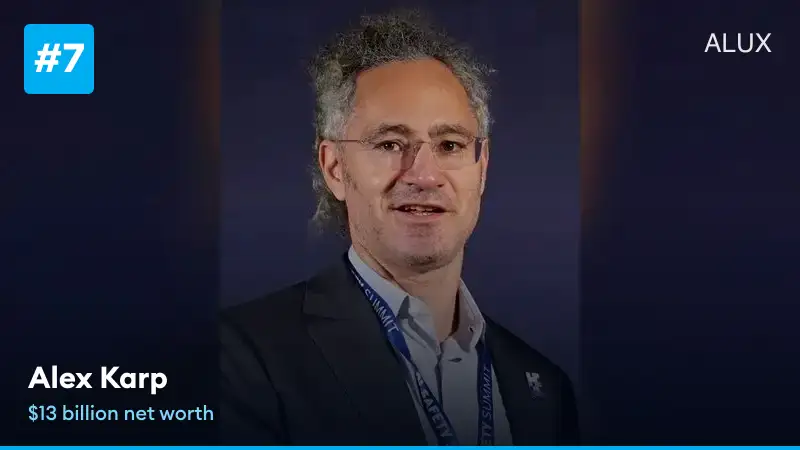
Karp co-founded Palantir in 2003 with Peter Thiel and others, and has been CEO ever since. He holds a law degree from Stanford and a PhD in social theory from Goethe University in Frankfurt, which makes him perhaps the only tech chief who wrote a dissertation on aggression in everyday language.
For most of its life Palantir was a secretive data company with government clients and a stock investors argued about. Its AI platform changed that. Corporate customers lined up from 2023 onward, revenue growth sped up, and the share price climbed so far that Palantir is now worth about $386 billion. Karp owns tens of millions of shares plus a large pile of options.
We count his Palantir shares and vested options, net of the stock he has already sold and the tax on the options. That comes to about $13 billion, in line with our Alex Karp net worth profile.
6. Daniela Amodei: $14.2 billion
Daniela Amodei is Anthropic’s president and the person who runs much of the company’s commercial side. Before AI she worked in global health, then joined Stripe in its early days, then spent years at OpenAI running safety and policy teams. In 2021 she left with her brother Dario and five colleagues to start Anthropic.
Each of the seven co-founders kept a similar stake, so their fortunes rise together. When the company was valued at $380 billion in February 2026, each was worth a few billion dollars. After the $965 billion round in May, each was worth well over $10 billion on paper.
Her number counts the roughly 241 million Anthropic shares listed for her in the company’s October 2026 IPO filing, at about $58.90 a share. That comes to about $14.2 billion.
5. Dario Amodei: $15.5 billion
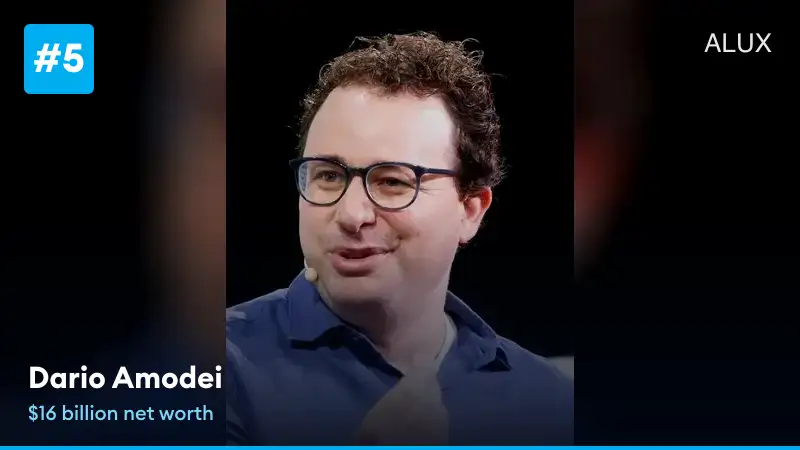
A physicist by training, Dario Amodei did research at Baidu and Google Brain before becoming vice president of research at OpenAI, where he helped lead work on GPT-2 and GPT-3. He left in 2020 over disagreements about how fast and how safely to build, and founded Anthropic the following year.
His bet was that a lab focused on safety could also compete at the frontier. The Claude models became a favorite with programmers and companies, revenue grew at a pace few software companies have ever seen, and in May 2026 Anthropic’s valuation hit about $965 billion, passing OpenAI. Amodei, the company’s chief executive, writes long essays about where AI is heading that get read across the industry.
His stake has not been published in the same detail as his sister’s. At roughly 1.6% of Anthropic at the May 2026 valuation, it is worth about $15.5 billion, which matches the figure on our Dario Amodei net worth profile.
4. Edwin Chen: $18 billion
Edwin Chen studied math and linguistics at MIT, then worked on machine learning at Google, Facebook and Twitter. He kept running into the same problem: the human-labeled data that models needed was sloppy. In 2020 he started Surge AI to do it properly, hiring skilled writers, coders and specialists to produce training data.
The unusual part is that Surge never took venture money. It was profitable early, reportedly passed $1 billion in revenue in 2024, and counts the top AI labs as customers. Because nobody diluted him, Chen owns roughly three quarters of the company, which is why he became the richest of the new AI billionaires counted in early 2026.
The figure rests on a roughly 75% stake in Surge AI at the value implied by its revenue and reported fundraising talks, which put Chen at about $18 billion.
3. Chen Tianshi: $23 billion
Chen Tianshi was a child prodigy who entered the University of Science and Technology of China at 16. With his brother Chen Yunji he worked on AI processors at the Chinese Academy of Sciences, and in 2016 he spun that research out as Cambricon Technologies.
For years Cambricon lost money. Then US export limits made it hard for Chinese companies to buy Nvidia’s best chips, and buyers turned to local alternatives. Cambricon’s revenue exploded, it turned profitable, and its shares in Shanghai rose many times over. At one point in 2025 it was briefly the most expensive stock in China by share price.
Chen holds about 28% of Cambricon directly, and Cambricon had a market value of roughly $80 billion in early November 2026. That stake works out to about $22.6 billion, and a small indirect holding through a partnership brings him to about $23 billion.
2. Liang Wenfeng: $42 billion
Liang Wenfeng first got rich running High-Flyer, a quantitative hedge fund in Hangzhou that used machine learning to trade Chinese stocks. He bought thousands of Nvidia GPUs for the fund before export limits kicked in, and in 2023 he used that hardware to start DeepSeek.
In January 2025 DeepSeek released R1, a reasoning model that matched top American systems while reportedly costing a fraction as much to train. Nvidia lost nearly $600 billion of market value in a single day as investors panicked about cheap AI. DeepSeek ran on his own money until June 2026, and Liang still controls most of it, so his fortune depends on what investors will pay for a lab with that reputation.
DeepSeek’s first outside round in June 2026 finally put a price on it, and by our math Liang owns about 78% after that round. At that price his stake is worth about $41 billion, or $42 billion with his share of High-Flyer, and that is the softest number on the list. A second round reported in October would put him near $60 billion if its terms are confirmed.
1. Jensen Huang: $155 billion
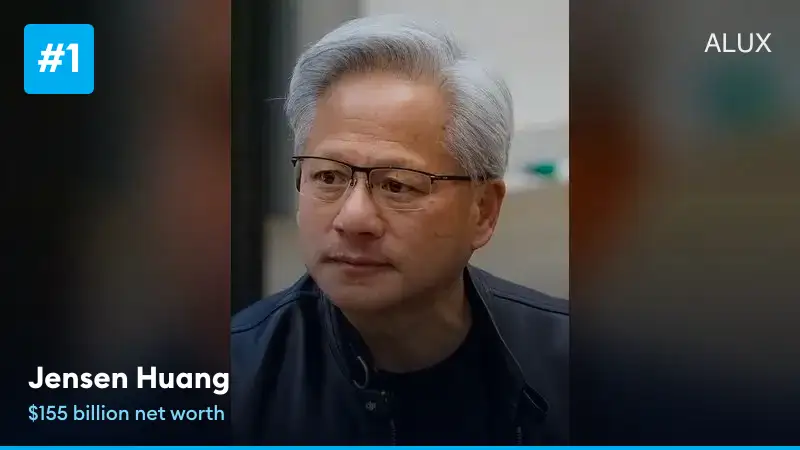
Huang was born in Taiwan, moved to the US as a child and washed dishes at Denny’s as a teenager. He co-founded Nvidia in 1993, reportedly sketching the plan in a Denny’s booth, and has run it ever since, which makes him one of the longest-serving founder CEOs in tech.
For twenty years Nvidia sold graphics cards to gamers. The decision that made Huang the king of this list came in 2006, when Nvidia released CUDA so scientists could program its chips. When deep learning took off, it ran on Nvidia hardware. Today the company sells most of the processors that train and run AI, and it is worth about $4.51 trillion.
Huang owns about 3.5% of Nvidia, directly and through trusts. At the early November share price that stake is worth roughly $155 billion, below the $200 billion on our Jensen Huang net worth profile, which was set near the stock’s peak.
Special mentions
- Tom Brown, Jack Clark, Jared Kaplan, Sam McCandlish and Chris Olah: The other five Anthropic co-founders hold stakes similar in size to the Amodeis’, each worth billions on paper. We ranked the CEO and president and grouped the rest here so seven near-identical entries do not crowd the list.
- Elon Musk: The richest person alive owns xAI, maker of Grok, which became part of SpaceX in 2026. His fortune was built by Tesla and SpaceX, so he sits outside the ranking.
- Larry Ellison: Oracle’s giant AI cloud contracts sent his fortune soaring in 2025, but the money was made selling databases decades earlier.
- Liu Debing: Chairman of Zhipu AI, one of the first Chinese model makers to list in Hong Kong. His fortune swung from about $2 billion to over $20 billion in 2026 as the stock rocketed and fell, too wild to pin down.
What the richest AI billionaires have in common
Look at the ten and a pattern jumps out: most of them got rich selling picks and shovels, and only a few by selling the gold. Huang and Chen Tianshi make chips. Edwin Chen, Wang and Foody sell training data and the human experts behind it. Only the Amodeis and Liang built frontier models themselves, and their fortunes are paper valuations that no public market has yet tested.
The other pattern is speed. Half of the ten were not billionaires three years ago. Foody, Wang and Edwin Chen built their fortunes in an industry so new it did not have a name in 2019. And two of the top three are Chinese, which says something about how quickly China has built its own AI stack under export restrictions.
The habits that let people afford this
Short audio lessons on money, mindset and discipline, in the Alux app.
Get the Alux app →FAQ
Who is the richest AI billionaire?
Jensen Huang, co-founder and CEO of Nvidia, with an estimated net worth of about $155 billion in November 2026. Almost all of it is his roughly 3.5% stake in Nvidia.
How much are the Anthropic founders worth?
Dario Amodei is worth about $15.5 billion on paper, based on Anthropic’s $965 billion valuation from May 2026, and Daniela Amodei about $14.2 billion, based on the shares listed for her in the October 2026 IPO filing. The other five co-founders hold stakes of a similar size.
Who is the youngest AI billionaire on the list?
Brendan Foody of Mercor, who became a billionaire at 22 along with his two co-founders when the company raised money at a $10 billion valuation.
Is Sam Altman an AI billionaire?
Sam Altman is a billionaire, but most of his money comes from early investments in companies like Stripe and Reddit, not from OpenAI equity. His fortune of a few billion dollars would not make the top ten.
How much does the number 10 AI billionaire have?
Brendan Foody, at number 10, has an estimated net worth of about $2.2 billion.
Why is Elon Musk not on the list?
Musk owns xAI, but his fortune was built by Tesla and SpaceX. We only ranked people whose wealth comes mainly from AI.
How we estimate net worth
Our estimates are based on public reporting, company valuations, and deal and earnings figures all compiled in an internal valuation model. They are approximate, and figures change over time as new information emerges.
Keep reading
- How the AI gold rush is making people rich
- Are we in an AI bubble?
- The most common ways to become a self-made billionaire
Last updated: November 2026.