Giancarlo Devasini, the chairman of stablecoin issuer Tether, is the richest person in Italy as of November 2026, with a net worth we estimate at about $89 billion. This ranking covers Italian citizens, wherever they happen to live, and counts everything they own: founded companies, inherited ones and family stakes. Several of the people below run their fortunes from Brussels, St. Moritz, the French Riviera or Buenos Aires, which is a very Italian way of being Italian.
For decades the answer to this question was a chocolate spread. Then crypto arrived. Two Tether executives now sit in Italy’s top three, either side of the heir to Nutella, with a former bond trader who built a financial software group in London close behind. Further down, the list reads like a tour of what Italy does best: cars, coffee machines, cement, medicine and steel pipes.
| Rank | Name | Net worth (USD) | Main source of wealth |
|---|---|---|---|
| 10 | Giuseppe De’Longhi | $5.5 billion | De’Longhi appliances |
| 9 | Gianfelice Rocca | tied at $6.5 billion | Techint Group, Humanitas |
| 8 | Paolo Rocca | tied at $6.5 billion | Techint Group (Tenaris, Ternium) |
| 7 | Piero Ferrari and family | $8.9 billion | Ferrari |
| 6 | Massimiliana Landini Aleotti and family | $10 billion | Menarini pharmaceuticals |
| 5 | Francesco Gaetano Caltagirone | $12 billion | Cement, Generali, media |
| 4 | Andrea Pignataro | $19 billion | ION Group |
| 3 | Paolo Ardoino | $38 billion | Tether |
| 2 | Giovanni Ferrero | $53 billion | Ferrero confectionery |
| 1 | Giancarlo Devasini | $89 billion | Tether |
Italy’s ten richest, from tenth to first
10. Giuseppe De’Longhi: $5.5 billion
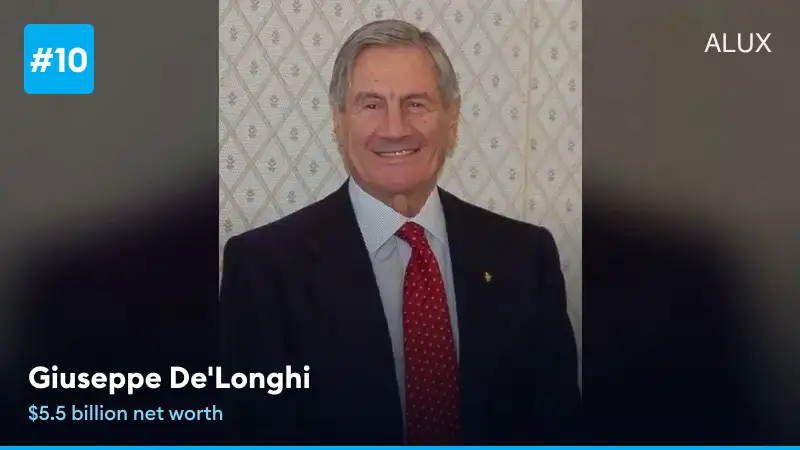
If there is an espresso machine on your kitchen counter, there is a fair chance the name on it is De’Longhi. Giuseppe De’Longhi took a small Treviso workshop that made parts for heaters and turned it into one of the world’s biggest makers of home coffee machines, portable air conditioners and kitchen gadgets, with brands like Kenwood and Braun household under the same roof.
He is still chairman, while his son Fabio runs the company as CEO. The family has always known when to sell, too: in 2015 Giuseppe sold his majority stake in the heating business DelClima to Mitsubishi Electric for $551 million. Coffee, the home-barista boom in particular, has done the heavy lifting since.
We value his controlling stake of about 53.5% in the Milan-listed De’Longhi SpA at its November 2026 share price, then add the cash from the October 2026 sale of a stake in the coffee business and the DelClima money. That comes to about $5.5 billion.
9. Gianfelice Rocca: $6.5 billion
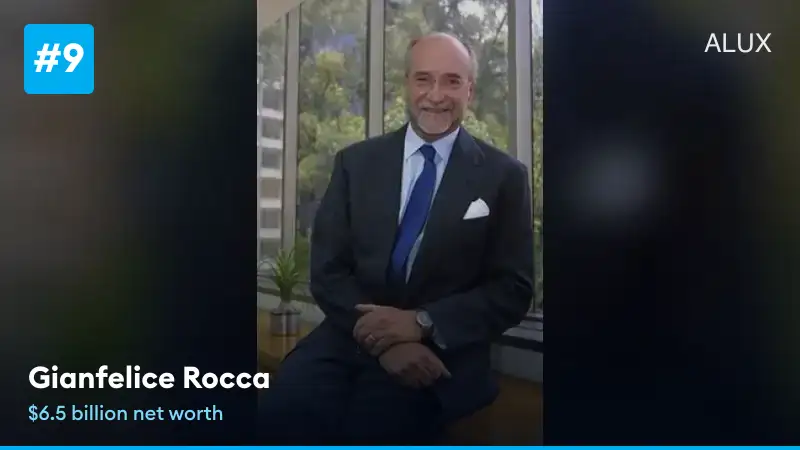
The Rocca family story starts in 1945, when engineer Agostino Rocca founded Techint in Milan and soon took it to Argentina. Three generations later, the group makes the high-pressure steel pipes that oil and gas wells depend on, plus flat steel, engineering projects and hospitals, with more than $38 billion in yearly revenue.
Gianfelice is the brother who stayed closer to home. He chairs the Techint holding and built Humanitas, the hospital and medical research group based in Milan, into one of Italy’s best-known health networks. He has also been a leading voice in Italian industry associations.
The family owns about 39.7% of San Faustin, the holding at the top of Techint, and we credit each brother with half. Looked through to the listed stakes in Tenaris and Ternium plus the private businesses, his share comes to about $6.5 billion, the same as his brother’s.
8. Paolo Rocca: $6.5 billion
Paolo Rocca runs the industrial side of Techint from Buenos Aires, where he has lived for decades. As chairman and CEO of Tenaris and chairman of Ternium, he oversees pipe mills on several continents and a steel business that is one of the largest in Latin America. Around 78,000 people work for the group.
Steel and pipes are not glamorous, and they swing with oil prices and tariffs. Still, the family’s patient ownership through cycles in Argentina, Mexico and Italy has kept the fortune growing for 80 years.
The figure comes from his half of the family’s 39.7% of San Faustin, looked through to listed Tenaris and Ternium and to the private Techint businesses, the same method we use for his brother.
7. Piero Ferrari: $8.9 billion
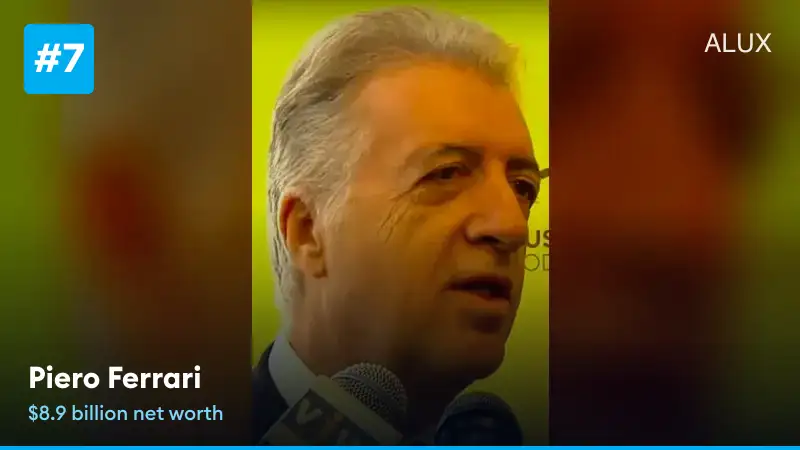
Piero Ferrari is the son of Enzo Ferrari, and for a long part of his early life he could not even use the family name. He started at the Maranello factory in the 1960s, worked his way through the racing and production side, and today is vice chairman of what is probably the most profitable carmaker per vehicle on earth.
He owns about 10% of Ferrari, which listed in New York in October 2015 and has since become one of the stock market’s favourite luxury names. Ferrari sells fewer than 15,000 cars a year and still earns profits most carmakers would envy. He also holds a stake in the yacht builder Ferretti.
His wealth is almost entirely the family’s 10.6% of Ferrari at market value, plus the Ferretti shares and cash from dividends, about $8.9 billion in all.
6. Massimiliana Landini Aleotti and family: $10 billion
Most people outside medicine have never heard of Menarini, and that suits the family fine. The Florence drug company has 16 factories, more than 17,000 employees and over $4 billion in annual sales, from heart medicine to cancer treatments.
Alberto Aleotti joined Menarini in 1964 and bought it from its owners in the early 1990s. Massimiliana and her children inherited the company in 2014; daughter Lucia is chairman and son Alberto Giovanni is vice chairman. Menarini is private, so the family’s wealth is one of the least visible big fortunes in Europe.
We value Menarini on the profit multiple of a listed Italian drug maker, add part of what it spends on research, and credit the family with full ownership. The result, about $10 billion, belongs to the family as a whole: Massimiliana shares the company with her two children, and the split between them has never been published.
5. Francesco Gaetano Caltagirone: $12 billion
Caltagirone is Rome’s builder-financier. He took over his family’s construction business, grew it into a group that spans cement, property, finance and newspapers, and owns Il Messaggero, the capital’s best-known daily, through Caltagirone Editore. Cementir, his cement maker, sells in markets from Denmark to Turkey.
The bigger story is banking. Caltagirone is one of the largest shareholders in insurer Assicurazioni Generali, and alongside the Del Vecchio family he bought big stakes in Monte dei Paschi di Siena in 2024 and 2025. That bank then took over Mediobanca in 2025, a deal that reshuffled the top of Italian finance with Caltagirone close to the centre of it.
We add up his listed holdings in Generali, Monte dei Paschi, Acea and the Caltagirone group at market, plus his property at book value, for about $12 billion.
4. Andrea Pignataro: $19 billion
Andrea Pignataro, born in Bologna, was a bond trader at Salomon Brothers in London before founding ION Group in 1998. ION started with software for trading government bonds and then went on a buying spree, picking up names like Dealogic and Fidessa. Today it sells trading, analytics, banking and credit software to many of the world’s biggest financial institutions.
Pignataro is famously private, and ION is too, which is why he was barely known in Italy until early 2026, when some published rankings briefly placed him above Giovanni Ferrero. He lives in St. Moritz and also owns villas and hotels on the Caribbean island of Canouan. ION reported about $31 billion in net assets in 2024.
We value ION on the profit multiples of listed financial software companies, subtract roughly $11 billion of group debt, and add his Italian holdings at what he paid for them plus the Canouan estate. That gives about $19 billion, well below the $40 billion and more often quoted for him, which do not appear to subtract the debt.
3. Paolo Ardoino: $38 billion
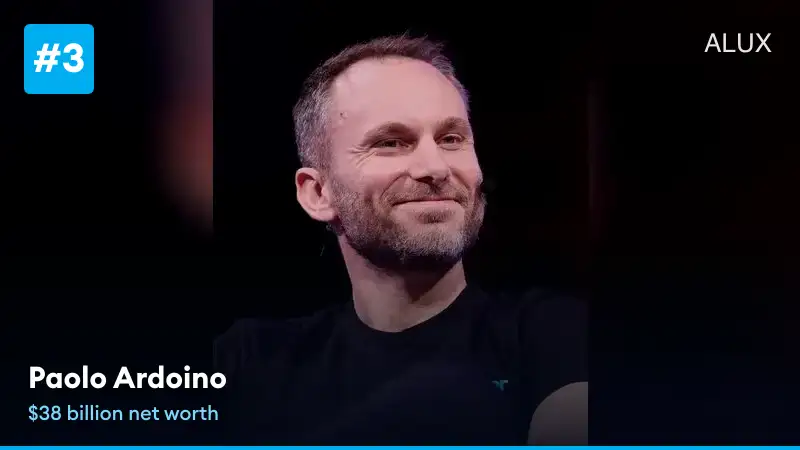
Paolo Ardoino grew up in Liguria and started as a programmer. In 2014 he joined crypto exchange Bitfinex as a software developer, rose to chief technology officer of its sister company Tether, and became Tether’s CEO at the end of 2023. At 42, he is the youngest person on this list by more than a decade.
Tether issues USDT, a token pegged to the dollar and backed mainly by U.S. Treasury bills. With more than 180 billion tokens in circulation, the interest on those reserves turns into enormous profits: more than $10 billion in 2025. Ardoino has used that cash to back bitcoin mining, AI and even Italian football, with Tether building a stake in Juventus. In 2026 the company sought outside investment at a target valuation of $500 billion.
His number reflects an estimated 20% stake in Tether, valued with the profit multiples of listed banks and asset managers rather than the headline $500 billion target.
2. Giovanni Ferrero: $53 billion
In 1946 Pietro Ferrero, a pastry maker in Alba, stretched scarce cocoa with hazelnuts and sold the paste in loaves. His grandson Giovanni now chairs the company that grew from it, with about $20 billion in yearly sales and brands that include Nutella, Kinder, Ferrero Rocher and Tic Tac.
Giovanni stepped down as CEO in 2017 to become executive chairman and has spent the last decade turning a European chocolate maker into a global snacks group. He bought Nestlé’s U.S. candy business for $2.8 billion in 2018 and cereal maker WK Kellogg for $3.1 billion in 2025. He lives in Brussels, and he was Italy’s richest person for years until the crypto boom pushed him into second.
Ferrero is private, so we value its parent company, wholly his, at the profit multiple of listed confectioners, about 14.6 times its roughly €3.2 billion in yearly operating profit before depreciation. The result is about $53 billion.
1. Giancarlo Devasini: $89 billion
Few billionaires have taken a stranger route to the top. Giancarlo Devasini, born in Turin, is reported to have trained in medicine before going into business importing and selling computer parts. In the crypto years he became a key figure at Bitfinex and then chairman of Tether, now the most profitable company in digital money.
Devasini is believed to be Tether’s largest shareholder, with an estimated 45% of the company. He almost never gives interviews and lives on the French Riviera, in Roquebrune-Cap-Martin. Tether’s profits over the past three years, driven by high interest rates on its reserves, turned his stake into one of the largest fortunes in Europe. That makes him about two thirds richer than Giovanni Ferrero, a gap nobody would have predicted five years ago.
We started from Tether’s reported profits, applied the valuation multiples of listed mid-sized banks and asset managers, and credited him with roughly 45% of the result.
Special mentions
- The Del Vecchio heirs: the eight heirs of Luxottica founder Leonardo Del Vecchio each own 12.5% of the holding company Delfin and are worth about $6 billion to $7 billion apiece. Counted together, the family would rival Giovanni Ferrero for second place on this list.
- Marina and Pier Silvio Berlusconi: the eldest children of Silvio Berlusconi run Fininvest and MFE-MediaForEurope and are worth about $3 billion each.
- Miuccia Prada and Patrizio Bertelli: the couple behind Prada are each worth about $5 billion, short of tenth place, yet they remain Italy’s richest fashion family.
What Italy’s richest have in common
Seven of the ten fortunes on this list come from family companies, and most of those families have stayed in control for more than one generation. Italy is a country of patient, closely held businesses, and the numbers show it. Ferrero, Menarini and Techint are all private or controlled through private holdings, which means their owners rarely sell and rarely explain themselves.
The newcomers broke that pattern. Devasini, Ardoino and Pignataro built their money in finance and crypto, outside Italy, and in less than 30 years. Together they now hold more wealth than the other seven names combined. Italy’s industrial fortunes are big and stable; its newest fortunes are bigger and far more volatile, and almost none of the money is made at home.
The habits that let people afford this
Short audio lessons on money, mindset and discipline, in the Alux app.
Get the Alux app →FAQ
Who is the richest person in Italy?
Giancarlo Devasini, chairman of Tether, is the richest Italian in November 2026 with an estimated net worth of about $89 billion.
Is Giovanni Ferrero still the richest Italian?
No. Ferrero ranks second with about $53 billion. Devasini passed him thanks to Tether’s huge profits.
How much money do you need to be among the 10 richest people in Italy?
About $5.5 billion. Giuseppe De’Longhi holds tenth place with roughly that amount.
How many billionaires does Italy have?
Italy had close to 90 billionaires on the main 2026 global ranking, up from 74 a year earlier.
Who is the richest woman in Italy?
Massimiliana Landini Aleotti heads the largest Italian fortune led by a woman: she and her two children own the Menarini drug company, worth about $10 billion to the family as a whole.
Why do so many rich Italians live abroad?
Many run international businesses from financial centres like London, Brussels or Switzerland, and some families have lived abroad for generations, like the Roccas in Argentina. They keep their Italian citizenship, which is why they count here.
How we estimate net worth
Our estimates are based on public reporting, company valuations, and deal and earnings figures all compiled in an internal valuation model. They are approximate, and figures change over time as new information emerges.
Keep reading
- How billionaire families manage money through family offices
- The great wealth transfer between generations
- What economic moats are and why they protect wealth
Last updated: November 2026.