Wizkid is the richest musician in Nigeria as of November 2026, with a net worth we estimate at about $50 million from shows, records and brand deals. This list covers Nigerian singers, rappers and producers, active or semi-retired, ranked by the wealth their music careers built. Family money that came from outside music is set aside, which matters more than usual here, because one of the top three was born into a very rich family.
Nobody on this list files public accounts, and estimates you will see elsewhere for the same star often differ by a factor of three. We built ours from what can be checked: label deals, tour grosses, sold-out venues, endorsement contracts and property, then rounded down where the evidence was thin.
| Rank | Name | Net worth (USD) | Main source of wealth |
|---|---|---|---|
| 10 | Tiwa Savage | $10 million | Music, Universal deal, endorsements |
| 9 | Kizz Daniel | $12 million | Hits, touring, Flyboy Inc. |
| 8 | Timaya | $14 million | Music, Lagos real estate |
| 7 | D’banj | $16 million | Music, CREAM platform, endorsements |
| 6 | 2Baba | $18 million | Catalogue royalties, endorsements, nightlife |
| 5 | Olamide | $20 million | YBNL label, music |
| 4 | Burna Boy | $40 million | Stadium touring, streaming |
| 3 | Davido | tied at $45 million | Touring, endorsements, DMW label |
| 2 | Don Jazzy | tied at $45 million | Mavin Records sale and stake |
| 1 | Wizkid | $50 million | Touring, Puma deal, streaming |
The ranking: 10 down to 1
10. Tiwa Savage: $10 million

Tiwa Savage spent her early career singing backup for George Michael and Mary J. Blige and writing songs for other artists in the US. She moved home to Lagos in the early 2010s and quickly became the biggest female star in Afrobeats, the first woman to rival the men at the top of Nigerian pop.
In 2019 she signed a global deal with Universal Music Group, and in 2023 she performed at the coronation concert for King Charles III at Windsor Castle, a gig that made headlines across Africa. She owns the masters to many of her early songs, which means more of each stream ends up with her, and she has fronted campaigns for Pepsi and Maggi.
The estimate starts from her reported minimum fee of $150,000 a show, keeps about a third of that after costs, and adds her homes in London and Lagos, her recordings and a decade of brand deals. That comes to about $10 million.
9. Kizz Daniel: $12 million

Few Nigerian songs of the decade traveled like “Buga.” The 2022 single with Tekno became a dance challenge from Lagos to Nairobi to London, and it made Kizz Daniel one of the most booked live acts in Africa. He had already scored with “Woju” in 2014, and he has had a steady run of hits since.
He runs his own label, Flyboy Inc., which he started in 2017 after leaving his first label, so he keeps a larger share of his recording income than most artists of his generation. Most of his money comes from shows, where his fee rose sharply after “Buga.”
We put him at about $12 million, built from show savings, his label, cars and homes. Few of his deals have public figures, so most of those rows are our own assumptions.
8. Timaya: $14 million
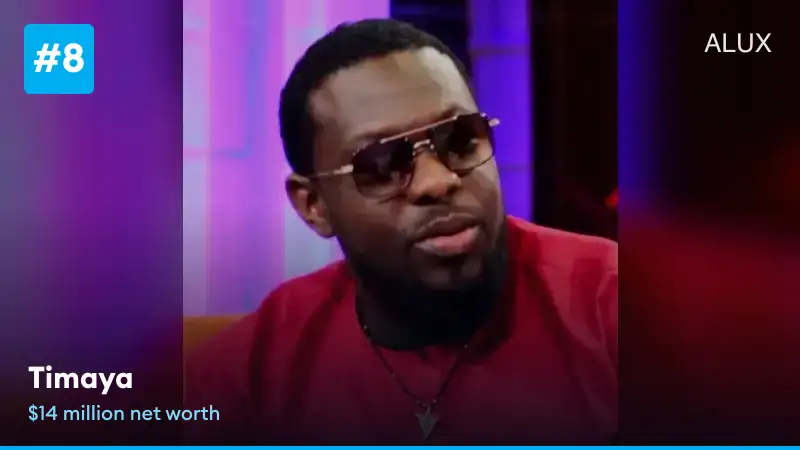
Timaya came out of Port Harcourt in the mid-2000s with a raspy dancehall style that sounded like nobody else in Nigeria. Twenty years later he is still touring, still releasing music, and still running his label, DM Records.
His smartest move had nothing to do with music. He bought land in Lekki, Lagos, early, before the area turned into one of the most expensive parts of the city, and those plots are now worth several billion naira. He also owns property in Port Harcourt and has endorsed Glo and Hennessy.
We rest the figure mainly on his Lagos and Port Harcourt property, plus catalogue and show income, which two estimates of $14 million both support.
7. D’banj: $16 million

D’banj and Don Jazzy built Mo’ Hits Records together in 2004, and for a few years it was the hottest label in Africa. In 2011 D’banj signed with Kanye West’s G.O.O.D. Music, and his song “Oliver Twist” reached the UK top 10 in 2012, one of the first Nigerian pop songs to get there.
His later money has come more from business than records. He founded CREAM, a digital platform for creators and small businesses that has partnered with MTN, and he has endorsed Globacom and a long list of consumer brands. He was also a co-owner of the Koko Garri food brand.
We put him at $16 million, at the low end of what has been published, since the value of CREAM has not been tested by an outside investment we can see.
6. 2Baba: $18 million
Innocent Idibia, better known as 2Baba (or 2Face), wrote “African Queen” in 2004. The song was featured in the Hollywood film Phat Girlz, played at weddings across the continent for twenty years, and still earns him royalties. He was one of the first Nigerian pop stars to sell outside Nigeria at scale.
Beyond the catalogue he has a long run of endorsements with Airtel and Guinness, owns a nightclub franchise and invests in real estate. He tours less these days, and his income leans more on royalties than new releases.
Our number is built on catalogue value and property, landing near the middle of a published $15 million to $27 million range.
5. Olamide: $20 million

Olamide is the best talent spotter in Nigerian music. He founded YBNL in 2012 and launched the careers of Lil Kesh, Fireboy DML and Asake, three of the biggest acts of the past decade. When Asake broke out in 2022, YBNL owned a piece of one of Africa’s hottest new artists.
In 2020 YBNL signed a joint venture with a San Francisco independent distributor for international releases, which gives Olamide back-end income from every artist on the roster. He also raps in Yoruba, still sells out shows and has endorsed Cîroc and Goldberg.
Most of the estimate is YBNL itself, valued against that distribution deal and its roster, plus his own catalogue. That gives about $20 million, matching the upper end of a published range.
4. Burna Boy: $40 million
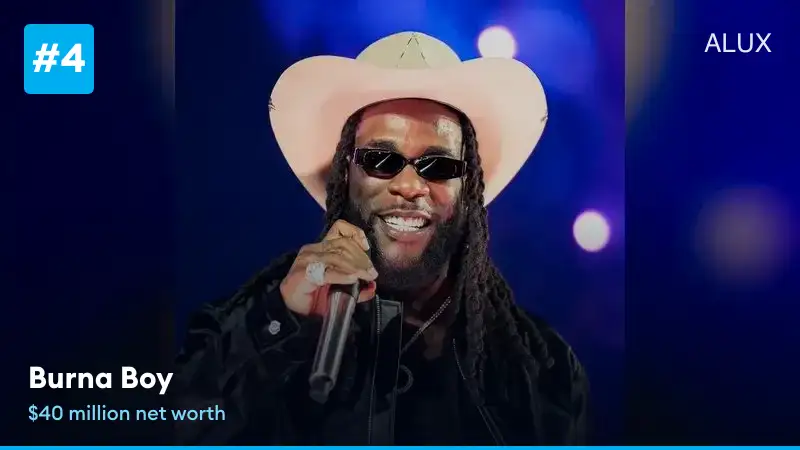
Burna Boy is the Nigerian star with the biggest live business. In 2023 he became the first African artist to headline a UK stadium, filling London Stadium with about 80,000 fans, and the same year he sold out Citi Field in New York. His “I Told Them” tour reportedly grossed about $30 million across 22 shows, which would make it the top tour ever by an African act.
He won the Grammy for Best Global Music Album in 2021 for Twice as Tall, and his songs “Last Last” and “Ye” each pulled in hundreds of millions of streams. He owns an eight-bedroom house in Lekki and runs his own Spaceship label.
Touring drives our figure: we applied typical artist shares to his reported grosses and added streaming, endorsements and property. The result, about $40 million, sits inside the published range of $22 million to $45 million.
3. Davido: $45 million

David Adeleke grew up between Atlanta and Lagos and dropped out of business school in Alabama to make music. “Dami Duro” made him a star in 2011, “Fall” became one of the first Afrobeats songs to be certified gold in the US, and his 2023 album Timeless sent him on a world tour, with the first three North American dates of a later run reported to gross more than $1.6 million.
He fronted a Martell cognac campaign in 2021, runs his own DMW label and has invested in startups. He has sold out the O2 Arena in London and Madison Square Garden in New York, and his endorsement list runs from Pepsi and MTN to Infinix and Puma.
Davido comes from one of Nigeria’s wealthiest business families, and none of that money is counted here. Our $45 million covers only what his music career built: touring, recording, endorsements and his label. Reported show grosses of $0.5 million to $1.2 million a night do not support the higher figures in circulation, and we have seen no confirmed brand equity.
2. Don Jazzy: $45 million
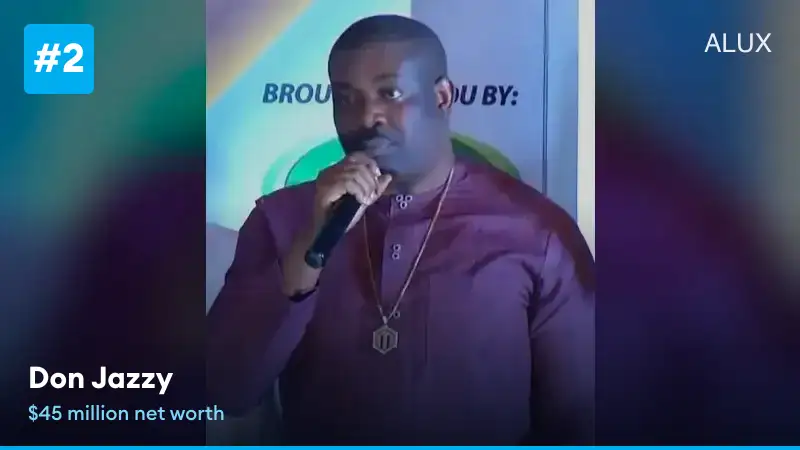
Michael Collins Ajereh started making beats as a teenager, co-founded Mo’ Hits with D’banj in 2004 and launched Mavin Records in 2012. Mavin became the most successful label in Africa, with Tiwa Savage, Rema, Ayra Starr, Johnny Drille and others on its roster. “Calm Down” by Rema became one of the most streamed African songs ever.
The payday came in two parts. In 2019 the investment firm Kupanda Holdings bought into Mavin. In 2024 Universal Music Group took a majority stake, in a deal that reportedly valued the label at well over $125 million, with talk of $150 million to $200 million. Don Jazzy still runs Mavin as CEO and kept a stake, and he has investments in Nigerian startups.
His estimate rests on his share of the Mavin sale proceeds plus his remaining equity in the label, at the reported deal values. We set it at about $45 million, level with Davido and above older estimates that predate the deal.
1. Wizkid: $50 million

Ayodeji Balogun grew up in Surulere, Lagos, and was recording songs before he was a teenager. “Holla at Your Boy” made him famous in 2010, and a decade later he was a global star: a Grammy for “Brown Skin Girl” with Beyoncé, and “Essence” with Tems, which reached the Billboard Hot 100 top 10 on its remix with Justin Bieber.
He has sold out London’s O2 Arena three nights running, signed a large deal with Puma in 2022, and has endorsed Pepsi and Glo. He runs Starboy Entertainment and has a home in Los Angeles. His albums, from Made in Lagos to Morayo, keep his streaming income among the highest of any African artist.
We combined touring, recordings and songwriting, endorsements and his Starboy label to arrive at about $50 million. That is enough to put him narrowly ahead of Don Jazzy and Davido, who are level.
Special mentions
- DJ Cuppy: Florence Otedola is a DJ and producer, but her wealth comes from her father, one of Nigeria’s richest businessmen, so she stays outside the ranking.
- Davido’s family: His father built a large business group spanning energy and other industries. Had we counted inherited family money, Davido would lead the list by a wide margin.
- Peter and Paul Okoye: As P-Square the twins were Africa’s biggest duo, and their 2022 reunion tour reportedly grossed over $5 million. Estimates for each twin run from about $3 million to $16 million, too wide a spread to rank them with confidence.
What the richest Nigerian musicians have in common
- Ownership beats fame. The people near the top own something: a label (Don Jazzy, Olamide, Davido, Wizkid) or their own masters. Hits alone made many stars rich; owning the pipeline made a few of them very rich.
- The real money is abroad. The biggest paydays came from London, New York and Paris arenas and from dollar-denominated streaming, which matters in a country where the naira lost much of its value against the dollar in 2023 and 2024.
- Lagos property is the default savings account. Almost every artist here has put money into Lekki or Banana Island real estate, which has held its value better than cash.
- Labels are the exit. The only outright sale on the list, Mavin to Universal, created the biggest single payday. Expect more Afrobeats labels to sell stakes to global majors.
The habits that let people afford this
Short audio lessons on money, mindset and discipline, in the Alux app.
Get the Alux app →FAQ
Who is the richest musician in Nigeria?
Wizkid, with an estimated net worth of about $50 million in November 2026, counting only money from his music career.
Is Wizkid richer than Davido?
Yes, narrowly. We estimate Wizkid at about $50 million and Davido at about $45 million, counting only their music money. Davido would be far ahead if his family’s wealth were included.
How much is Burna Boy worth?
About $40 million by our estimate, driven by stadium tours that reportedly grossed around $30 million on the “I Told Them” run alone.
How much did Don Jazzy sell Mavin for?
The price was not disclosed. Universal Music Group bought a majority stake in 2024 in a deal reported to value Mavin at more than $125 million, possibly up to $200 million.
How much does the number 10 on the list have?
Tiwa Savage, at number 10, has an estimated net worth of about $10 million.
Who is the richest female musician in Nigeria?
Tiwa Savage, at about $10 million, built through shows, her Universal deal, owned masters and endorsements.
How we estimate net worth
Our estimates are based on public reporting, company valuations, and deal and earnings figures all compiled in an internal valuation model. They are approximate, and figures change over time as new information emerges.
Keep reading
- How rich people get paid forever
- Surprising ways to make money without a traditional job
- The assets that hold their value the longest
Last updated: November 2026.