Aliko Dangote is the richest person in Nigeria as of November 2026, with a fortune we estimate at about $48 billion, driven by his cement company and the giant Lekki oil refinery. He is worth more than the other nine people in this top ten combined. The list ranks Nigerian citizens who live in Nigeria and built their fortunes there, from cement and sugar to telecoms, banking and oil.
Two quick notes. Nigerian fortunes swing hard with the naira and with thinly traded shares on the Lagos exchange, so a billionaire can gain or lose hundreds of millions in a day. And several older business families keep their finances private, which makes the bottom half of this list an estimate with wider error bars than the top.
| Rank | Name | Net worth (USD) | Main source of wealth |
|---|---|---|---|
| 10 | Cosmas Maduka | $300 million | Coscharis Group, car distribution |
| 9 | Oba Otudeko | $350 million | Honeywell Group |
| 8 | Mohammed Indimi | $500 million | Oriental Energy Resources |
| 7 | Jim Ovia | $600 million | Zenith Bank stake, real estate |
| 6 | Folorunsho Alakija | $900 million | Famfa Oil, Agbami oilfield |
| 5 | Femi Otedola | $1.7 billion | Power generation, bank shares |
| 4 | Tony Elumelu | $2.5 billion | Heirs Holdings, Transcorp, UBA |
| 3 | Mike Adenuga | $4.2 billion | Globacom, Conoil |
| 2 | Abdul Samad Rabiu | $17 billion | BUA Cement, BUA Foods |
| 1 | Aliko Dangote | $48 billion | Dangote Cement, Dangote Refinery |
Nigeria’s 10 richest people, from 10 to 1
10. Cosmas Maduka: $300 million
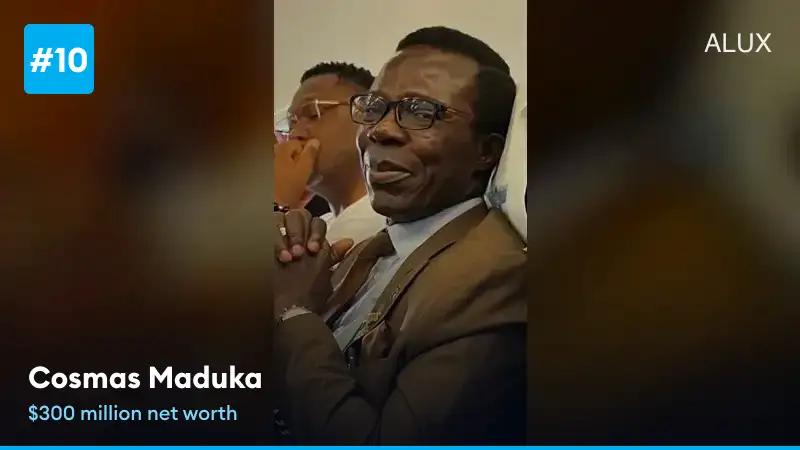
Cosmas Maduka started Coscharis Motor in 1977 with 300 naira, selling motor parts in the south-east. Five years later Coscharis won one of only ten motor import licenses the government handed out, and the business never looked back.
Coscharis now sells and services BMW, Land Rover and Ford vehicles, assembles Ford Ranger pickups locally and runs a rice farm in Anambra State on land approved at 5,000 hectares. Maduka also sat on the board of Access Bank for twelve years.
His fortune was put at about $500 million in 2015. We cut it to $300 million because the naira has lost most of its dollar value since then, which shrinks any business that earns in local currency.
9. Oba Otudeko: $350 million
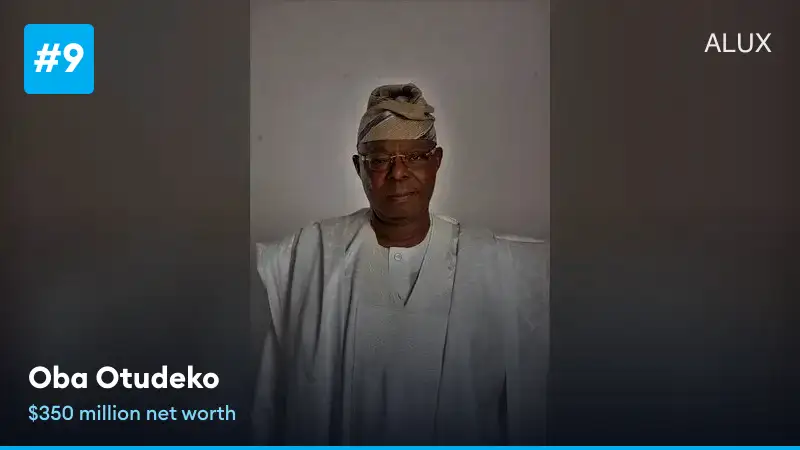
Otudeko was a career banker, rising to acting chief executive of Cooperative Bank in Ibadan, before he left in 1983 to build the Honeywell Group. Honeywell began as a trading company and spread into flour milling, energy, real estate and shipping.
His best trade came in telecoms. Honeywell led a consortium that won one of Nigeria’s first GSM licenses, the network that later became Airtel Nigeria, and sold its Airtel holdings to Bharti Airtel in 2013. He later chaired First Bank of Nigeria and its holding company.
Our estimate starts from a 2014 valuation of $550 million, then marks it down for the weaker naira and for Honeywell’s exit from flour milling, where the mills were sold to Flour Mills of Nigeria.
8. Mohammed Indimi: $500 million
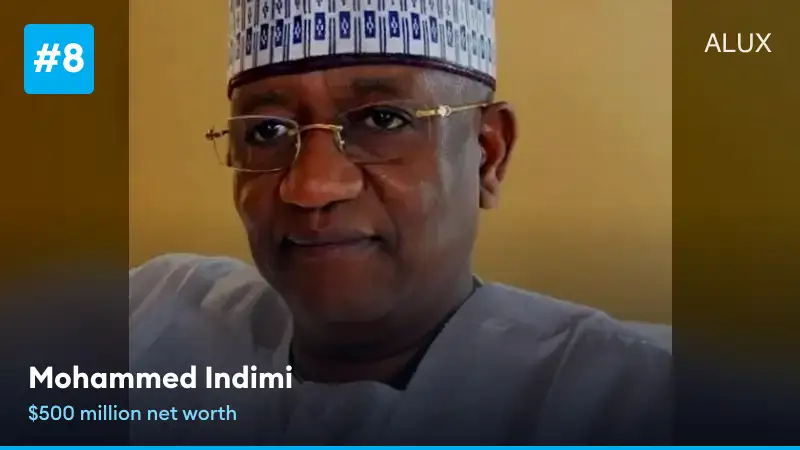
Indimi started trading hides, skins and imported clothing in 1963, while still a teenager. In 1990 he obtained an oil prospecting licence, which became the foundation of Oriental Energy Resources, a private oil exploration and production company that he still chairs.
He has served on several boards, including Jaiz Bank, Nigeria’s first full Islamic bank. His wealth has been dented over the years by falling oil prices and the floating of the naira.
We value his roughly 29% of Jaiz Bank at market, about $70 million, and add Oriental Energy and his property and cash. That comes to about $500 million, with Oriental Energy, which is private, as the biggest and least certain piece.
7. Jim Ovia: $600 million
Jim Ovia founded Zenith Bank in 1990 with a thin licence and a big bet on technology. Zenith grew into one of the largest banks in Nigeria, and Ovia, now its chairman, is still its biggest individual shareholder with a little more than 9%.
Visafone, a mobile operator he started, was later sold to MTN. Ovia owns prime real estate across Nigeria and founded James Hope University in Lagos. In March 2025 the City of London gave him the Freedom of the City.
The figure rests mainly on his roughly 5.8 billion Zenith shares at November 2026 prices, about $506 million after Zenith nearly doubled this year, plus recent dividends and his other businesses. In all, about $600 million.
6. Folorunsho Alakija: $900 million
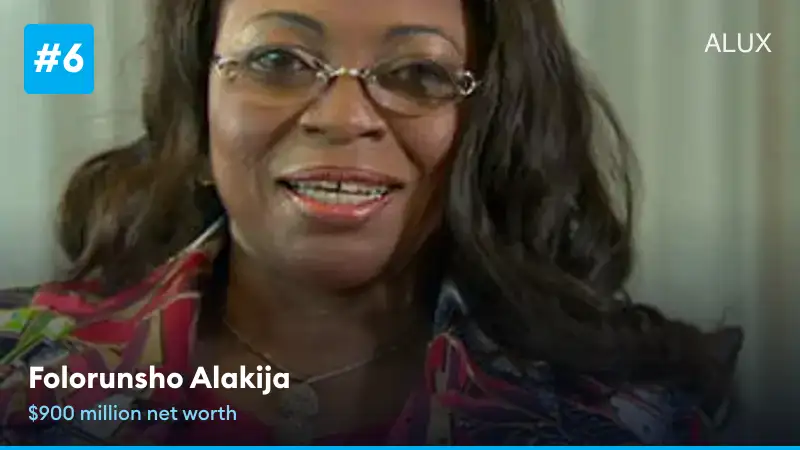
Alakija never went to university. She worked as a bank secretary, studied fashion in London and returned to Lagos to dress Nigeria’s elite, including the wife of a former head of state. In 1993 she applied for an oil prospecting licence and won the rights to a 617,000-acre offshore block.
That block turned out to contain part of the Agbami field, one of Nigeria’s largest deepwater discoveries, developed with Chevron. Her company, Famfa Oil, fought the federal government in court over its share and won at the Supreme Court in 2012. In 2025 she donated a 250-bed teaching hospital, valued at 34 billion naira, to Osun State University.
We price her company’s share of Agbami off the $710 million Equinor received for its 20.21% of the field in 2024, halve it for partner costs and the government’s take, and add cash and her other businesses. The total is about $900 million. Agbami is a mature field, so the risk on this number points down. She remains the richest woman in Nigeria.
5. Femi Otedola: $1.7 billion
Femi Otedola made his first fortune trading and distributing diesel. In 2019 he sold his shares in Forte Oil and moved into electricity, buying control of Geregu Power, a gas-fired plant that he later listed on the Nigerian exchange.
In 2025 he sold his majority stake in Geregu for roughly $750 million, keeping about 5%. Beyond power, Otedola holds shares in Zenith Bank and First Bank’s holding company, and he keeps homes on three continents. His daughter is the DJ known as Cuppy.
Two recent valuations put him at $1.6 billion and $1.9 billion. We sit between them, with the Geregu cash doing most of the work.
4. Tony Elumelu: $2.5 billion
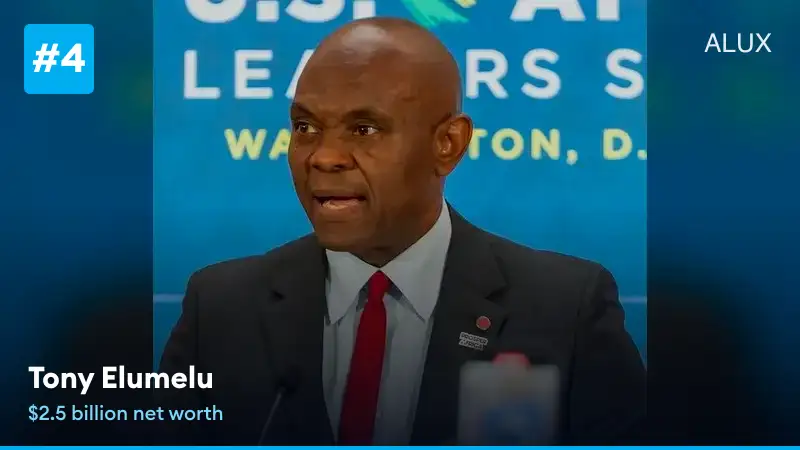
In 1997 a 34-year-old Tony Elumelu led a group of investors who took over a struggling Lagos bank. He turned it into Standard Trust Bank and in 2005 merged it with the much older United Bank for Africa, which now runs in 20 African countries plus France, the United States and Britain.
He founded Heirs Holdings in 2010 as his family’s investment vehicle. Through it he controls Transcorp, which owns hotels, power plants and oil assets, and he has interests in insurance and healthcare. Its oil arm, Heirs Energies, also holds a large indirect stake in Seplat Energy, which has climbed sharply in value. In August 2026 he retired as UBA chairman under the central bank’s 12-year limit for board members. His foundation has pledged $100 million to fund 10,000 African entrepreneurs.
His figure adds his UBA shares, the listed Transcorp companies and the private Heirs businesses, including the Seplat holding. Local 2026 estimates run from about $2.1 billion to $3.2 billion before any borrowing is netted out, so we settle near the middle at about $2.5 billion, above the $1.6 billion on our older profile.
3. Mike Adenuga: $4.2 billion
Mike Adenuga paid for his MBA in New York by driving a taxi. Back home, he made his first million by 26 selling lace and distributing soft drinks. In 1991 his Consolidated Oil struck oil in shallow waters off Ondo State, the first Nigerian-owned company to find oil in commercial quantities.
His biggest business is Globacom, which won a mobile licence at auction in 2003 and became one of Nigeria’s largest networks, with operations in Ghana and Benin and its own submarine cable to Europe. On top of that sit 74% of Conoil, a listed fuel retailer, oil blocks in the Niger Delta and a slice of Sterling Bank.
Globacom is private, so we value it at three quarters of what the market pays per subscriber for MTN Nigeria, then add Conoil, Sterling Bank, the oil assets and property. The result, about $4.2 billion, is below the $7 billion often quoted, because we price Glo below the market leader.
2. Abdul Samad Rabiu: $17 billion
Rabiu inherited land from his father, but he built BUA Group from a trading start in 1988, importing rice, edible oil, steel and chemicals. In 2008 BUA opened what was then the second-largest sugar refinery in sub-Saharan Africa and ended a long monopoly in Nigeria’s sugar market.
Cement made him a multibillionaire. BUA built a $900 million plant in Edo State, merged its cement businesses in 2020 and listed BUA Cement in Lagos, where Rabiu owns about 98% of the shares. BUA Foods, about 93% his, turns out sugar, flour and pasta. With so few shares in public hands, small trades can move his net worth by hundreds of millions of dollars in a day.
We price his stakes in BUA Cement and BUA Foods at November 2026 share prices, about $7.3 billion and $9.4 billion, and add a little for the rest of the group. That gives about $17 billion. Older estimates near $12 billion used lower share prices.
1. Aliko Dangote: $48 billion
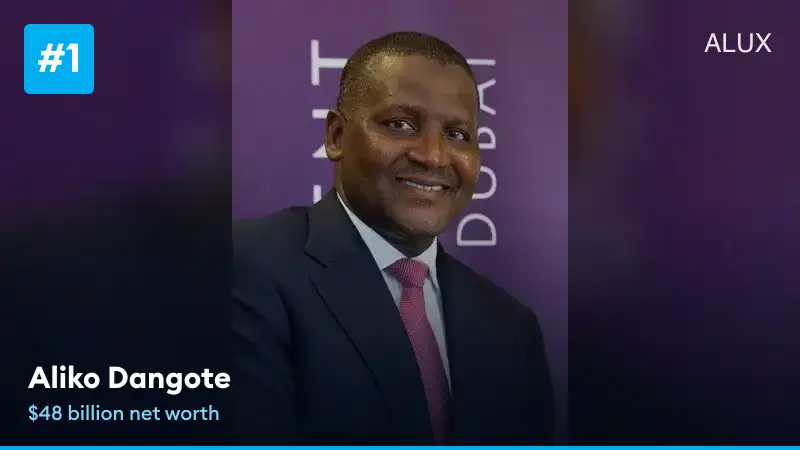
Aliko Dangote started trading commodities in Lagos in 1977 with a loan from his uncle. He moved into sugar, flour and salt, then into cement, where Dangote Cement now produces about 48.6 million tonnes a year across ten African countries. He owns roughly 85% of it.
The bigger story is the refinery. Construction of the Dangote Refinery near Lagos began in 2016 and refining started in early 2024. With a design capacity of 650,000 barrels a day, it is the largest refinery in Africa, and its opening roughly doubled his fortune. In 2026 an oversubscribed private placement put a fresh value on the business, and the company began offering shares to individual investors. In September 2026 he also announced funding for a fuel pipeline and storage link between Ethiopia and Djibouti, and he owns a fertilizer plant that opened in 2022.
Valuations of the refinery differ widely, which is why two recent estimates of his fortune sit at $39 billion and $54 billion. Our $48 billion splits the gap and matches our current Dangote profile.
Special mentions
- Adebayo Ogunlesi: the Lagos-born co-founder of Global Infrastructure Partners, sold to BlackRock in a $12.5 billion deal, is worth about $2.7 billion, but he is a U.S. citizen who built his fortune in New York.
- Tope Awotona: the Calendly founder, born in Lagos, is worth about $1.4 billion. He is also a U.S. citizen based in Atlanta.
- Tunde Folawiyo: runs the Yinka Folawiyo Group, but the company was founded by his father, so his fortune counts as inherited.
What Nigeria’s richest people have in common
Almost every fortune here began with trading. Dangote, Rabiu, Adenuga, Maduka, Indimi and Otedola all started by importing or distributing goods, from sugar and lace to car parts and diesel, and then used the cash and relationships to build factories or win licences. The second stage is where the real money appears, because licences and plants create scale that traders cannot copy. Look at the top three. Each owns something that is very hard to replicate in Nigeria: a cement network, a refinery, a national mobile network. The last pattern is a warning. Fortunes held in naira assets have lost huge sums in dollar terms over the past decade, so the richest Nigerians increasingly sell abroad, list companies or earn in hard currency.
The habits that let people afford this
Short audio lessons on money, mindset and discipline, in the Alux app.
Get the Alux app →FAQ
Who is the richest person in Nigeria in 2026?
Aliko Dangote is the richest person in Nigeria and in Africa, with an estimated net worth of about $48 billion in November 2026.
Who is the richest woman in Nigeria?
Folorunsho Alakija, the oil and fashion entrepreneur, is the richest woman in Nigeria with an estimated $900 million, mostly from her company’s stake in the Agbami oilfield.
How many billionaires are there in Nigeria?
Five people on our list are clearly worth more than $1 billion: Dangote, Rabiu, Adenuga, Elumelu and Otedola. Folorunsho Alakija sits just below the line, at about $900 million.
How did Aliko Dangote make his money?
He started as a commodities trader, built Africa’s largest cement company and then opened the Dangote Refinery in 2024, which roughly doubled his fortune.
How much is the 10th richest person in Nigeria worth?
Cosmas Maduka, founder of the Coscharis Group, is 10th with an estimated $300 million.
Why do Nigerian billionaires’ fortunes change so fast?
Their main assets are priced in naira and many trade thinly on the Lagos exchange, so currency moves and small share trades can shift their net worth by hundreds of millions of dollars.
How we estimate net worth
Our estimates are based on public reporting, company valuations, and deal and earnings figures all compiled in an internal valuation model. They are approximate, and figures change over time as new information emerges.
Keep reading
- Self-made billionaires who started poor
- The places where it is easiest to get rich
- How to build a billion-dollar business
Last updated: November 2026.