Jim Walton is the richest heir in the world as of November 2026, with a fortune we estimate at about $127 billion, nearly all of it Walmart stock his father handed down. This list ranks living people whose wealth came mainly through inheritance: shares, companies or family holdings passed down from a parent, grandparent or spouse. Some of them run the family business and some never worked there a day, but none of them started it.
Inherited fortunes tend to be concentrated in a single asset, so they move with one share price or one private company valuation. With four Waltons in the ten, the list is, in effect, a chart of Walmart’s stock.
| Rank | Name | Net worth (USD) | Inherited fortune |
|---|---|---|---|
| 10 | Lukas Walton | $34 billion | Walmart (US) |
| 9 | Alain Wertheimer | $40 billion | Chanel (France) |
| 8 | Abigail Johnson | $42 billion | Fidelity Investments (US) |
| 7 | Jacqueline Mars | $49 billion | Mars Inc. (US) |
| 6 | John Mars | $49 billion | Mars Inc. (US) |
| 5 | Julia Koch and family | $81 billion | Koch Inc. (US) |
| 4 | Françoise Bettencourt Meyers | $97 billion | L’Oréal (France) |
| 3 | Alice Walton | $124 billion | Walmart (US) |
| 2 | Rob Walton | $125 billion | Walmart (US) |
| 1 | Jim Walton | $127 billion | Walmart (US) |
From 10 to 1
10. Lukas Walton: $34 billion

The youngest person on this list is a grandson of the Walmart founder, still in his late thirties. He inherited a large part of his father John Walton’s Walmart holding as a young man, and for years he was the family member the public knew least about.
That changed when he started putting his money to work. In 2019 he set up Builders Vision, an investment platform that backs sustainable farming, clean energy and ocean projects, and he has become one of the bigger private funders of climate startups in the US. His fortune still rides mostly on Walmart shares, which is why it climbed with the stock.
We count his share of the Walmart stock held directly by Walton Enterprises, the family holding company, at November prices, plus retained dividends and a stake in the Chicago Bulls. Shares held in charitable trusts are left out because they are not his. That gives about $34 billion, lower than figures that count those trusts.
9. Alain Wertheimer: $40 billion

The Chanel story is a strange one. In 1924 Pierre Wertheimer, a French businessman, agreed to fund and distribute Coco Chanel’s perfumes in exchange for most of the profits. Chanel No. 5 became the best-selling fragrance in the world, and over the following decades the Wertheimer family ended up owning the entire fashion house. Pierre’s grandsons, Alain and his younger brother Gérard, have controlled it since the 1970s.
Alain took charge in 1974, when the brand had gone stale and was sold in too many drugstores. He pulled its perfume out of cheap outlets, hired Karl Lagerfeld in 1983 to design the fashion line, and turned Chanel back into a name with waiting lists. He lives in New York and holds the title of global chairman. The brothers also own racehorses and Bordeaux’s Château Rauzan-Ségla, none of which they discuss, because they almost never give interviews.
We value Chanel, which posts annual sales close to $19 billion, at about 16 times its $4.7 billion operating profit, midway between the multiples of two listed luxury groups, and give Alain half. Add his half of the family wine and racehorse interests and its family office and he comes to about $40 billion.
8. Abigail Johnson: $42 billion

Fidelity Investments was founded in Boston in 1946 by Edward C. Johnson II. His son Ned built it into one of the largest fund companies in the world, and Ned’s daughter Abigail took the CEO job in 2014. She is the third generation of Johnsons to run the firm, which manages trillions of dollars for retirement savers.
Johnson is an heir who actually works the job: she started as an analyst, managed funds and ran several divisions before reaching the top. Under her watch Fidelity moved early into cryptocurrency custody and launched a bitcoin fund.
She holds a stake of roughly 28% in privately owned Fidelity. Our estimate of about $42 billion follows the latest tracked figure for that stake, a little below the number on our older Abigail Johnson net worth profile.
7. Jacqueline Mars: $49 billion

Frank C. Mars started making candy in his kitchen in Tacoma, Washington, in 1911. His son Forrest added M&M’s and the global ambitions, and the company grew into a confectionery and pet food giant: Snickers, Twix, Pedigree, Whiskas, Royal Canin and hundreds of veterinary clinics. Forrest’s children, Jacqueline and John, each own about a third of it.
Jacqueline worked at the company for about two decades and later sat on its board. Today she spends her time on horses and on supporting the arts in the Washington area. Mars still has no public shares, and the family has never sold any.
Her figure is a one-third stake in Mars, which we value using its sales of over $50 billion a year and recent acquisition prices in packaged food. That points to roughly $49 billion.
6. John Mars: $49 billion

John Mars worked his way up through the business and served as chairman for years before handing control of the board to the next generation. He lives in Wyoming and stays almost totally out of public view, even by Mars family standards.
The company he helped run has kept buying. In 2025 Mars completed its roughly $36 billion purchase of Kellanova, the maker of Pringles and Cheez-It, the biggest deal in its history. That made the private company even larger, and the family is now worth more than $120 billion together.
His estimate matches his sister’s: an equal share of Mars, about $49 billion at our valuation of the combined company.
5. Julia Koch and family: $81 billion

Koch Inc., based in Wichita, Kansas, is one of the largest private companies in America. It makes Georgia-Pacific paper towels, Guardian glass, Molex electronics, fertilizer and much more, with annual revenue well above $100 billion. David Koch owned about 42% of it alongside his brother Charles, and in 2019 that stake passed to Julia Koch and their three children.
Julia, who grew up in Arkansas and moved to New York to work in fashion, is now one of the richest women in the world. The family keeps its stake in the company and has been selling some of its real estate, including a large Manhattan apartment listed for $60 million.
We value Koch Inc. at 1.5 times its yearly revenue of more than $125 billion and credit the family with 42% of it, then add stakes in the New York Giants and the Brooklyn Nets’ parent company. That comes to about $81 billion.
4. Françoise Bettencourt Meyers: $97 billion
Her grandfather Eugène Schueller founded L’Oréal in 1909 after inventing a hair dye. Her mother Liliane was the main shareholder for decades, and Françoise and her two sons now control about a third of the world’s largest beauty company. She is vice chair of L’Oréal’s board, and the family holds several other seats.
Outside business she is a scholar of an unusual kind. She has published a five-volume study of the Bible and a book on the genealogy of the Greek gods, and she is a serious pianist. For several years she was the richest woman on Earth, until the Walmart stock rally pushed Alice Walton past her.
The family group holds about 185.7 million L’Oréal shares, close to 35% of the company, worth about $93 billion at early November 2026 prices. Add an estimate for the family investment company and retained dividends and the total is roughly $97 billion.
3. Alice Walton: $124 billion
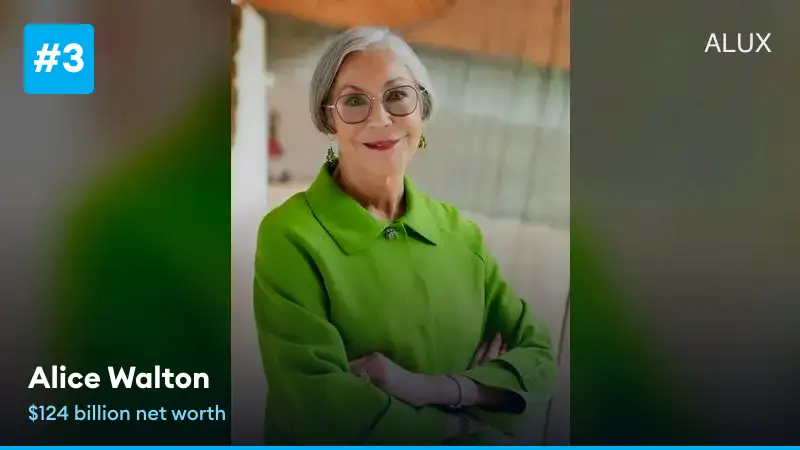
The only daughter of Sam Walton is also the richest woman in the world. Unlike her brothers she never worked in the family business for long. Her passion was art, and in 2011 she opened Crystal Bridges Museum of American Art in Bentonville, Arkansas, which now holds works worth well over a billion dollars and charges no admission.
Her newest project is a medical school, the Alice L. Walton School of Medicine, which opened in Bentonville in 2025. Her fortune is mostly Walmart shares held directly and through the family’s holding company, and it has risen with the stock, which crossed $1 trillion in market value in early 2026.
Our model gives her about $124 billion: a quarter of the Walmart shares held by the family holding company and family trust, her own shares at November prices, and cash from past sales and dividends after tax.
2. Rob Walton: $125 billion

Samuel Robson Walton is Sam Walton’s eldest son. He first worked for the law firm that handled Walmart’s legal work, joined the company itself in 1978, and served as chairman of the board from 1992 to 2015, after his father, so he is the heir who spent the most time steering the company itself.
Since leaving the board he has become best known for football. In 2022 he led the group that bought the Denver Broncos for $4.65 billion, then a record for a sports team. His daughter Carrie Walton Penner and son-in-law Greg Penner are part of the ownership group, and Greg is now Walmart’s chairman.
We put him at about $125 billion: a quarter of the Walmart shares held by the family holding company and family trust, his own shares, after-tax cash from past sales and dividends, and his stake in the Broncos.
1. Jim Walton: $127 billion

The youngest of Sam Walton’s children is the richest heir alive. He spent years in Walmart’s real estate department, buying land for new stores, and then took over Arvest Bank, the family’s bank in Arkansas, which has grown to dozens of billions of dollars in assets.
His Walmart holding is close to his siblings’, and the bank is what nudges him ahead. Walmart’s shares have been on a long run thanks to e-commerce, advertising and memberships, and the company was worth close to $1 trillion in November 2026. His son Steuart sits on Walmart’s board.
Walmart stock, after-tax cash from past sales and dividends, and his Arvest holding come to about $127 billion in our model. We give each of Sam Walton’s three surviving children an equal quarter of the family holdings, so the gaps between them come from their own shares and side assets: the three siblings sit within $3 billion of each other.
Special mentions
- Gérard Wertheimer: Alain’s younger brother owns the other half of Chanel and is worth about the same as his brother. He lives in Switzerland and has overseen Chanel’s watch business. We list him here rather than give Chanel two of the ten places.
- Mukesh Ambani: He inherited half of Reliance Industries, but he built most of today’s fortune himself through refining, telecoms and retail, so we count him as a builder.
- Klaus-Michael Kühne: The Swiss-based logistics billionaire inherited Kuehne+Nagel from his father and grandfather, then grew it into a world leader. Most of his wealth comes from that growth.
What the richest heirs and heiresses have in common
- They held on. Every family on this list kept control of one asset for generations instead of selling and diversifying. The Waltons, Mars and Wertheimers own the same companies their grandparents did.
- Private companies dominate. Mars, Koch, Chanel and Fidelity have no public shares. Families that avoid the stock market avoid takeover fights and quarterly pressure, and keep their wealth out of sight.
- Women do far better through inheritance. Half of the ten are women, compared with only a handful among the richest self-made billionaires.
- Consumer brands beat technology here. Discount stores, candy bars, shampoo and perfume built these fortunes. Products people buy every week compound for a century.
The habits that let people afford this
Short audio lessons on money, mindset and discipline, in the Alux app.
Get the Alux app →FAQ
Who is the richest heir in the world?
Jim Walton, the youngest son of Walmart founder Sam Walton, with an estimated net worth of about $127 billion in November 2026.
Who is the richest heiress in the world?
Alice Walton, at about $124 billion. She is also the richest woman in the world.
How much does the number 10 heir have?
Lukas Walton, grandson of the Walmart founder, is number 10 with an estimated $34 billion.
Which family has the most heirs on the list?
The Waltons, with four: Jim, Rob, Alice and Lukas. The Mars family has two.
Do these heirs run the family companies?
Some do. Abigail Johnson is CEO of Fidelity and Alain Wertheimer chairs Chanel, while Alice Walton and the Koch family are owners rather than managers.
Why are Bernard Arnault or the Ambanis not on the list?
We only count fortunes that were mainly inherited. Arnault built LVMH himself, and Mukesh Ambani grew Reliance far beyond what he inherited.
How we estimate net worth
Our estimates are based on public reporting, company valuations, and deal and earnings figures all compiled in an internal valuation model. They are approximate, and figures change over time as new information emerges.
Keep reading
- How billionaire families manage money through family offices
- Lessons rich parents teach their kids
- Buy, borrow, die: how the rich pass on wealth
- Assets rich people use to preserve wealth
Last updated: November 2026.