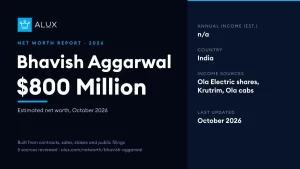
How much is Bhavish Aggarwal Worth? Bhavish Aggarwal Net Worth in 2026
Bhavish Aggarwal’s net worth is estimated at $0.8 billion as of November 2026, a rough figure with a plausible range of $0.5 billion to $1.2 billion.
His Ola Electric shares were worth about Rs 9,300 crore at the 2024 offer price and are worth roughly Rs 4,300 crore now. That is a paper loss of more than $500 million on the stake he still holds, and in October 2026 he pledged part of what remains to pay for a rights issue.
Aggarwal co-founded the ride-hailing company Ola, then built an electric scooter maker and an artificial intelligence company called Krutrim.
| Net worth | $0.8 billion (rough estimate, range $0.5 to $1.2 billion) |
|---|---|
| Estimated annual income | Not published; no salary figure we can support |
| Born | 1985, Ludhiana, India |
| Country | India |
| Known for | Founding Ola, Ola Electric and Krutrim |
| Main income sources | Shares in Ola Electric; stakes in private companies |
How much is Bhavish Aggarwal worth in 2026?
We put Aggarwal at about $0.8 billion. This one is a rough estimate: only one holding, his Ola Electric stake, has a public price. His stakes in Krutrim and the cab business are not disclosed, so those rows rest on stated assumptions.
Other estimates differ because some count Ola Electric alone, some add a private-company valuation without a stake size, and some are still based on the 2024 share price, which was roughly twice today’s.
How Bhavish Aggarwal built it
- Founded three companies. He co-founded Ola, then built Ola Electric, then the AI company Krutrim.
- Backed his own rights issue. In October 2026 he pledged 4.32 percent of Ola Electric to subscribe to a Rs 1,000 crore offer.
- Sold shares to cut debt. In December 2025 he sold 2.6 crore shares for about Rs 92 crore to repay promoter loans.
Learn the wealth mindset behind Bhavish Aggarwal’s career in the Alux app.
Get the Alux appHow we got to $0.8 billion
| Source | Our estimate | What it rests on |
|---|---|---|
| Ola Electric shares | $450 million | Indian Startup News reported he held 26.52 percent of the company on June 30, 2026. Autocar Pro says the 20 crore shares he pledged are 4.32 percent of the company, which implies about 4.63 billion shares in all, so his stake is about 1.23 billion shares. At about Rs 35 on 2 November 2026 that is about Rs 4,300 crore, or roughly $450 million at Rs 95 to the dollar. |
| Krutrim | $300 million | Assumption. The AI company was valued at $1 billion in a funding round that made it a unicorn in January 2024 (TechCrunch reported a $50 million round led by Matrix Partners India), and he has put in his own money. We do not know his stake, so we assume 40 percent of a value cut to $750 million after reports of job cuts in 2026. |
| Ola cabs (ANI Technologies) | $100 million | Assumption. The cab and mobility business was valued at several billion dollars at its peak. His holding is not disclosed, so we assume high single digit percent of a company worth about $1.5 billion today. |
| Loans against shares | minus $30 million | He sold shares in December 2025 to repay promoter loans of about Rs 260 crore in full, then pledged 20 crore Ola Electric shares in October 2026 to finance his rights issue subscription. The borrowing is not disclosed, so we deduct an assumed Rs 266 crore, which is 9.84 crore rights shares at Rs 27. |
The rows come to about $0.82 billion, which we round to $0.8 billion. Only the first row is documented. Removing both private-company rows leaves about $0.4 billion. Doubling the Krutrim row would take it to $1.1 billion.
The Rs 76 share that became Rs 35
Ola Electric listed in August 2024 with an offer price of Rs 76. Our calculation on today’s holding: 1.23 billion shares at Rs 76 is about Rs 9,330 crore; at Rs 35 it is about Rs 4,300 crore. The difference is about Rs 5,030 crore, or about $530 million, which is more than the entire stake is worth now.
In December 2025 he sold 2.6 crore shares at about Rs 35 for roughly Rs 92 crore, Outlook Business reported, to clear promoter debt. In early October 2026, Business Today reported, he pledged 4.32 percent of the company to fund his side of a Rs 1,000 crore rights issue, offered at Rs 27 a share, two shares for every 25 held. On our count he would take up about 9.8 crore shares, paying about Rs 160 crore now and the rest by October 2027.
Three companies, one public price
Ola Electric is the only company in his orbit where the market sets a price every day. Krutrim has not published a fresh valuation, and reports in 2026 describe a pivot toward AI cloud services and job cuts. The cab business is the oldest and the least transparent. Any of the three could move our total by more than the other two combined.
What would move the figure
Each Rs 1 on Ola Electric’s share price changes his stake by about Rs 123 crore, around $13 million. The rights issue closes the share count question, and a fresh Krutrim funding round would replace our assumption with a real number.
Bhavish Aggarwal net worth FAQ
What is Bhavish Aggarwal’s net worth?
Our rough estimate is $0.8 billion as of November 2026. Only his Ola Electric stake, about $450 million, is publicly priced.
How much of Ola Electric does Bhavish Aggarwal own?
About 26.5 percent himself as of June 30, 2026, or around 1.23 billion shares, and about 33 percent with the wider promoter group as of September 2026.
How much did Bhavish Aggarwal make selling Ola Electric shares?
In December 2025 he sold 2.6 crore shares at about Rs 35 each, roughly Rs 92 crore, to repay promoter loans.
What was Krutrim valued at?
$1 billion in the funding round of January 2024. No newer valuation has been published as far as we found.
How old is Bhavish Aggarwal?
He was born in 1985, so he is 41.
Why do estimates of Bhavish Aggarwal’s net worth differ?
Some use the 2024 Ola Electric price of Rs 76, which was twice today’s, and some add private valuations with no stake size. Ours is a wide range.
Related profiles
How we estimate net worth
Our estimates are based on public reporting, company valuations, and deal and earnings figures all compiled in an internal valuation model. They are approximate, and figures change over time as new information emerges.
Last updated: November 2026.