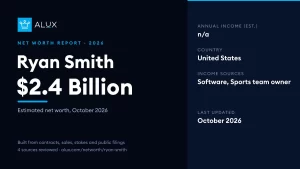
Ryan Smith
- Net worth $2.4 billion
- Birthday June 28, 1978
- Status -
- Country United States
- Source(-s) of wealth Entrepreneur
How much is Ryan Smith Worth? Ryan Smith Net Worth in 2026
Ryan Smith’s net worth is estimated at $2.4 billion as of November 2026. The Qualtrics co-founder sold the survey software company to SAP, then used the money to buy an NBA team and an NHL team in Utah. By the time Qualtrics was taken private for $12.5 billion in 2023, his own shares were worth only about $190 million.
| Net worth | $2.4 billion (rough estimate, range $1.5 billion to $4 billion) |
|---|---|
| Born | June 28, 1978, Eugene, Oregon |
| Country | United States |
| Known for | Qualtrics, Utah Jazz, Utah Mammoth |
| Main income sources | Sports franchises through Smith Entertainment Group, earlier Qualtrics sales |
How much is Ryan Smith worth in 2026?
This one is a rough estimate: the split of the Qualtrics sale among the Smith family, the debt on his teams and the teams’ current values are not published. What is documented is the sequence of deals. CIO Dive reported in November 2018 that SAP would pay $8 billion in cash, with the Smiths and other shareholders expected to receive about $7 billion. Wikipedia records that Qualtrics began trading in January 2021 at $41.85 and that Silver Lake and CPP Investment Board agreed in March 2023 to buy it for $12.5 billion in cash, closing in June.
Public estimates differ because they guess his Qualtrics proceeds and treat team values differently, and some assume he still held a large Qualtrics stake in 2023. An SEC filing shows he did not. A new arena or any change in the teams’ values are the main things that can move the figure.
How Ryan Smith built it
- Sold and cashed out. SAP bought Qualtrics for $8 billion, and his remaining shares were cashed out at $18.15 each in 2023.
- Put the money into teams. He bought the Utah Jazz in 2020 and an NHL expansion team in 2024.
- Sold a side asset. He sold his Real Salt Lake interest in April 2025.
Learn the wealth mindset behind Ryan Smith’s career in the Alux app.
Get the Alux appHow we got to $2.4 billion
| Source | Our estimate | What it rests on |
|---|---|---|
| Utah Jazz and Delta Center | about $1.0 billion | Wikipedia says he bought a majority of the team from the Miller family, announced October 28, 2020. We assume a team value near $3 billion, with debt and minority partners taking the rest. The price and the debt are not in what we read. |
| Utah Mammoth | about $0.5 billion | He paid a $1.2 billion expansion fee to the NHL’s other owners, per the team’s Wikipedia entry. We assume the franchise is worth about $1.5 billion today with loans against it. |
| Qualtrics cash-out, 2023, after tax | about $0.14 billion | A June 2022 SEC filing lists 10,351,350 Class A shares for Smith, including restricted stock units and 6,000,000 shares held through an LLC he manages. A June 2023 filing says every share was converted into $18.15 in cash and that he held none afterwards. 10.35 million times $18.15 is $188 million, and we assume about 25 percent tax. |
| Earlier Qualtrics money not in the teams, and Real Salt Lake | about $0.8 billion | The Hustle, citing Bloomberg, put the Smith family’s holding at 87.6 percent before the SAP sale, about $7 billion at the price. We assume Ryan’s share was a third, $2.3 billion before tax and $1.6 billion after 30 percent tax, and that about $1.0 billion of it went into the two teams, leaving about $0.6 billion. We add about $0.2 billion for the Real Salt Lake sale in April 2025, price not published. Every part of this row is an assumption. |
| Total | About $2.4 billion | $1.0 + $0.5 + $0.14 + $0.8 = $2.44 billion. |
Our calculation: his 2023 cash-out of $188 million is 1.5 percent of the $12.5 billion take-private price ($188 million divided by $12.5 billion). The famous number is the company’s; most of his money had already left Qualtrics in the 2018 sale, and then went into sports.
Two teams in four years
After buying the Jazz in 2020, Smith received the Utah NHL expansion franchise in April 2024 through Smith Entertainment Group, which the same entry says is controlled by him and his wife, Ashley. The hockey deal was two payments: the NHL paid the Coyotes’ owner $1 billion for the franchise, and Smith paid the league’s other owners $1.2 billion, so the $200 million difference ($200 million divided by $1.2 billion, about 17 percent of his fee) was a de facto relocation fee. The team became the Utah Mammoth in May 2025, and in 2026 it clinched the first wild card spot, its first playoff berth, then lost the first round 2 to 4 to Vegas. The Jazz went 22-60 in 2025-26, so the on-ice record is better for the hockey side than the basketball side, for now.
Why we do not trust one number
Smith’s money is now a bet on two franchises financed in part with debt, plus whatever is left of the Qualtrics sales. The franchise values and the loans are the unknowns. If Ryan’s share of the 2018 sale was a quarter instead of a third, the last row falls by about $0.4 billion, and if the Jazz are worth $4 billion instead of $3 billion with the same debt, the first row rises by up to $1 billion, less any partners’ share.
Ryan Smith net worth FAQ
What is Ryan Smith’s net worth?
We estimate $2.4 billion as of November 2026, with a range of $1.5 billion to $4 billion. It is a rough estimate because his team stakes and debts are private.
How much did Qualtrics sell for?
SAP bought it for $8 billion in cash in 2018 to 2019. In 2023 Silver Lake and CPP Investment Board took it private for $12.5 billion, and Smith’s remaining shares were cashed out at $18.15 each.
How much did Ryan Smith pay for the Utah NHL team?
A $1.2 billion expansion fee paid to the NHL’s other owners. Separately the NHL paid the Coyotes’ owner $1 billion, so $200 million was a de facto relocation fee split among the other clubs.
When did Ryan Smith buy the Utah Jazz?
The purchase was announced on October 28, 2020, and the NBA approved it that December.
How old is Ryan Smith?
He was born on June 28, 1978, so he is 48.
Related profiles
How we estimate net worth
Our estimates are based on public reporting, company valuations, and deal and earnings figures all compiled in an internal valuation model. They are approximate, and figures change over time as new information emerges.
Last updated: November 2026.