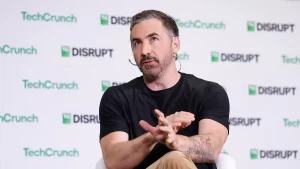
Kevin Rose
- Net worth $55 million
- Status -
- Country United States
- Source(-s) of wealth Entrepreneur, Investor
How much is Kevin Rose Worth? Kevin Rose Net Worth in 2026
Kevin Rose’s net worth is estimated at $55 million as of November 2026, and it is a rough estimate. A 2006 magazine cover said he had made $60 million in 18 months, and six years later the website behind that claim sold for $500,000. Most of our figure comes from what he did next: backing companies such as Twitter and Square with his own money.
| Net worth | $55 million (rough estimate, range $25 million to $120 million) |
|---|---|
| Estimated annual income | About $1 million, our assumption |
| Born | 1977, California |
| Country | United States |
| Known for | Founding Digg, angel investing, Proof and Moonbirds |
| Main income sources | Angel stakes, venture investing pay, company stakes |
How much is Kevin Rose worth in 2026?
We put him at $55 million, with a range of $25 million to $120 million. The range is that wide because his check sizes are private. A September 2026 review of his record by Angel Squad found that his bio names 11 personal angel investments but that no amounts, stakes or proceeds are public. Most of the money below is therefore our assumption, and the table says which parts are documented.
Public estimates disagree for the same reason: each one is a guess at those hidden checks, and a famous company on a bio can read as a big stake when it may have been a small one.
How Kevin Rose built it
- Backed startups early. His bio names Twitter, Facebook and Square among 11 personal angel investments.
- Bought his first company back. He and Alexis Ohanian bought Digg in March 2025 at an undisclosed price.
- Capped his riskiest bets. He reportedly limits angel and single-stock bets to 10 percent of his personal money.
Learn the wealth mindset behind Kevin Rose’s career in the Alux app.
Get the Alux appHow we got to $55 million
| Source | Our estimate | What it rests on |
|---|---|---|
| Digg, sold in 2012 | $0 | Documented: about $16 million for all the pieces against $45 million raised. Our assumption: investors came first and nothing from the sale reached him. The 2025 buyback price is undisclosed, so we carry that stake at zero too. |
| First angel stakes: Twitter, Facebook, Square, Zynga, Medium, Wealthfront | $30 million | The names are documented. The amount is our assumption: six stakes at about $5 million each before tax. He sold some Twitter shares in 2011, and the share count was never published. |
| Later private stakes: OpenAI, Anthropic, Oura, Solana, Magic Spoon | $20 million | The names are documented. The amount is our assumption: five stakes at about $4 million each, on paper, with no sale to prove the price. |
| Proof and Moonbirds | $5 million | Documented: a $50 million Series A in 2022 and a sale to Yuga Labs in February 2024 at an undisclosed price. The $5 million is our assumption, kept small because the money raised belonged to the company. |
| Pay and carried interest, 2011 to 2026 | $15 million | Our assumption: $1 million a year for 15 years across Milk, Google Ventures, Hodinkee and True Ventures. No pay figure is public. |
| Taxes and spending | minus $15 million | One third of realized money: $30 million in first stakes plus $15 million in pay is $45 million, and a third of that is $15 million. We assume returns on what he kept cover his spending, and count neither. |
| Total | $55 million | $70 million before tax, minus $15 million. |
The $60 million that was never there
The BusinessWeek cover of August 2006 read “How this kid made $60 million in 18 months.” Jason Fried of 37signals took it apart that week: the figure was 30 percent of a $200 million valuation credited to unnamed people, at a company estimated to bring in about $3 million a year. The story estimated his stake at 30 to 40 percent, a number Rose would not confirm.
Then came the real price. In July 2012, Betaworks paid $500,000 for the brand and site, the Washington Post paid $12 million for the team and LinkedIn paid about $4 million for the patents. By our calculation, 30 percent of that $16 million total is $4.8 million, before a single investor was repaid. Investors had put in $45 million, which is $29 million more than the whole sale brought. The $500,000 for the site itself works out to a quarter of 1 percent of the 2006 valuation.
His own rule doesn’t fit the numbers
Angel Squad reports that Rose’s 2024 personal playbook keeps 60 to 80 percent of his money in index funds and caps angel and single-stock bets at 10 percent. Our table can’t square with that. Angel stakes are $50 million of our $70 million before tax, or 71 percent. Taken literally, a 10 percent cap on $50 million would imply a $500 million portfolio, and nothing public supports a number that size. More likely the winners outgrew the rule, or his checks were smaller than we assume. That is why the bottom of our range sits at $25 million.
The one hard data point on the early stakes is thin. VentureBeat reported in September 2011 that he cashed out 20 percent of his Twitter shares in a funding round, while saying he still believed in the company. No price and no share count came with it.
A run of companies, few of them with prices attached
True Ventures backed his next startup, Milk, in 2011, and Google acquired it in 2012. He was a Google Ventures partner until 2015, ran the app lab North, became CEO of Hodinkee in July 2015 after Watchville merged with it, and joined True as a partner in 2017. In February 2025 True made him a full-time partner at a firm managing over $3.8 billion.
Moonbirds was the loud one. The 10,000 NFTs had $281 million in sales as of April 2022, and trading volume neared $500 million that month, but by the time Yuga Labs bought Proof in February 2024 the collection was generating less than $5 million a month. Yuga then sold Moonbirds on to Orange Cap Games, a move reported by June 2025.
Digg, third attempt
Rose and Alexis Ohanian bought Digg back in March 2025 at an undisclosed price, with True Ventures and Ohanian’s Seven Seven Six also investing. Early access cost $5 and was capped at 23,000 signups, so at most $115,000, or 23 percent of what the site fetched in 2012.
The open beta launched on January 14, 2026, and closed on March 14 after what its CEO described as a bot problem. Rose came back full time in April. On May 11, 2026, Digg returned as an AI news aggregator drawing on X, and Engadget reported he had also become CEO. We value none of this yet, since no funding or revenue figure is public.
What would move the figure
A sale or public listing at OpenAI or Anthropic would turn a guessed paper stake into a number, up or down. So would Digg finding an audience beyond AI news, which Rose has said is only the first topic.
Kevin Rose net worth FAQ
What is Kevin Rose’s net worth?
We estimate $55 million as of November 2026, with a range of $25 million to $120 million. That is $70 million before tax, minus $15 million in taxes, and most of it is our assumption.
How much did Kevin Rose make from selling Digg?
No payout is documented. The pieces of Digg sold for about $16 million in 2012 against $45 million raised, so we credit him nothing from that sale.
Did Kevin Rose make money on Twitter?
He sold shares, but the amount is unknown. VentureBeat reported in September 2011 that he cashed out 20 percent of his shares, with no price or share count given.
How much did Yuga Labs pay for Proof?
Yuga Labs declined to disclose the price in February 2024. Proof had raised a $50 million Series A in 2022, and we credit Rose $5 million as an assumption.
Who runs Digg now?
Rose returned full time in April 2026 and Engadget reported in May that he had also become CEO. He co-owns it with Alexis Ohanian.
How does Kevin Rose invest his own money?
Angel Squad reports 60 to 80 percent in index funds, with angel and single-stock bets capped at 10 percent, and holding periods of seven to 10 years or longer for angel deals.
Related profiles
- Tim Ferriss net worth
- Chris Sacca net worth
- Reid Hoffman net worth
- Marc Andreessen net worth
- Peter Thiel net worth
How we estimate net worth
Our estimates are based on public reporting, company valuations, and deal and earnings figures all compiled in an internal valuation model. They are approximate, and figures change over time as new information emerges.
Last updated: November 2026.
Photo: TechCrunch / Wikimedia Commons, CC BY 4.0, cropped